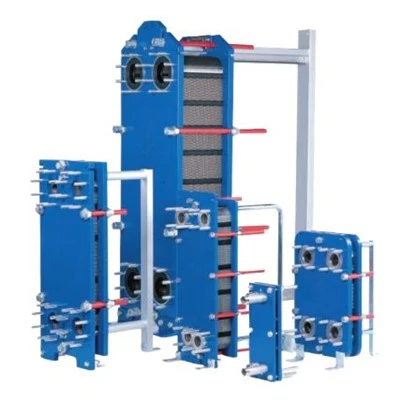
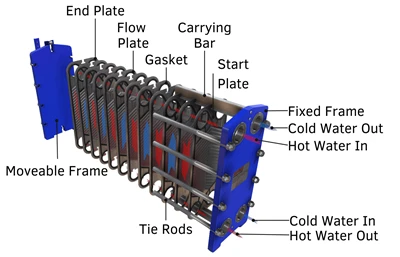
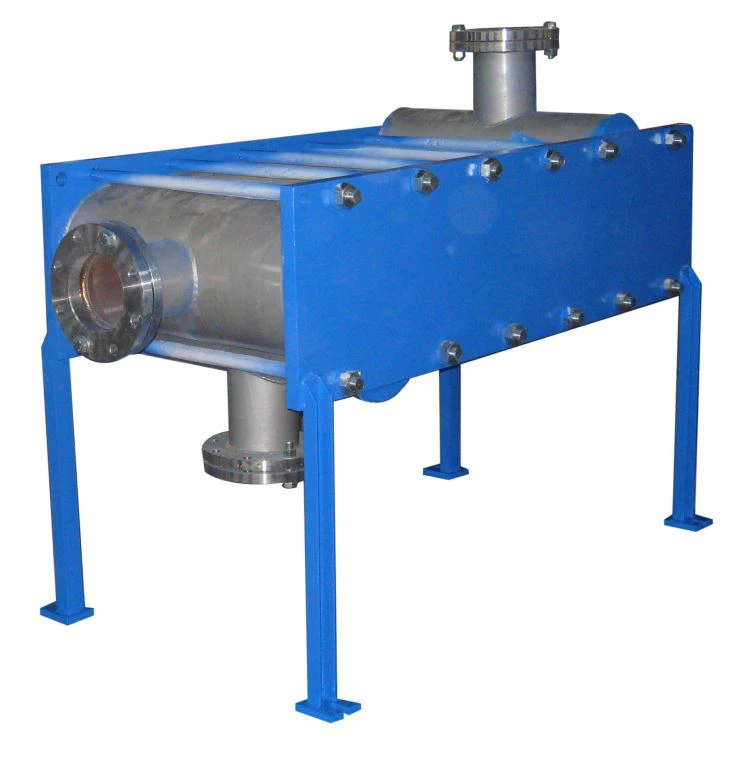
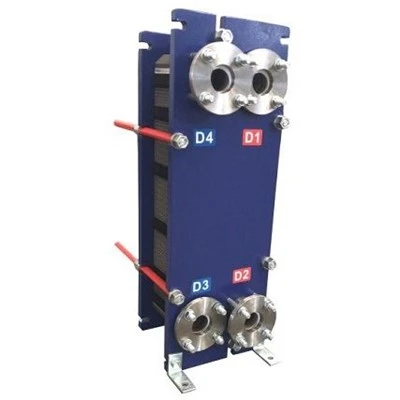
Standard gasketed, wide-gap and semi-welded plate heat exchangers use different channel and sealing constructions. A standard removable plate pack is suitable for many clean-fluid duties; a wide-gap design can help accommodate certain fibers, particles or viscous liquids; and a semi-welded design uses welded channel pairs for selected demanding services.

General pressed heat exchanger plate photograph. It does not represent all three constructions.
Three Plate Constructions and Their Main Functions
Removable Corrugated Plates
Thin pressed metal plates are assembled with gaskets in a bolted frame. The alternating channels separate the two fluids while allowing heat transfer.
The plate pack can be opened for suitable cleaning, inspection, regasketing or plate replacement according to the equipment procedure.
Larger Flow Passages
Wide-gap plate designs provide larger channel clearance in the relevant flow passages. This can help handle some fibrous, particulate or higher-viscosity media.
The actual free passage, flow velocity, fouling behavior and solids size must still be verified.
Welded Plate Pairs
In a typical semi-welded design, plates are joined into welded cassettes for one circuit while another circuit uses designated gasketed sealing arrangements.
These systems are evaluated for services that benefit from a welded channel boundary. Access and sealing differ from standard removable plates.
Scope: These are general engineering construction categories. They are not interchangeable plate products, and their appearance does not establish whether a given brand or model is available.
Standard vs Wide-Gap vs Semi-Welded: Practical Comparison
| Feature | Standard Gasketed | Wide-Gap | Semi-Welded |
|---|---|---|---|
| Primary distinction | Removable gasketed flow channels. | Increased clearance in selected channels. | Welded channel pairs with designated gaskets. |
| Fluid considerations | Suitable clean process and utility fluids. | Certain fibrous, particulate or viscous fluids. | Selected duties requiring welded sealing on one circuit. |
| Maintenance access | Individual plates can typically be separated. | Depends on the exact exchanger construction. | Welded cassette interiors cannot be opened like individual gasketed plates. |
| Selection priority | Thermal performance, gasket fit and service access. | Free passage, solids behavior and pressure loss. | Media containment, cassette integrity and seal design. |
| Replacement approach | Match the original individual plate and gasket. | Match the exact wide-channel geometry. | Identify the original cassette assembly and sealing system. |
Which Plate Type Fits Different Industrial Fluids?
Clean Water and Utility Circuits
Standard gasketed plate exchangers are widely considered for suitable hot water, chilled water, cooling-water and heat-recovery applications. Material, pressure, temperature and fouling conditions must be checked for the actual duty.
Fibrous or Particle-Containing Media
Where a conventional narrow channel is vulnerable to blockage, a wide-gap design may be evaluated. However, the minimum free passage, particle dimensions, fiber length, solids concentration and expected deposits matter more than the term "wide-gap" by itself.
Refrigeration and Demanding Process Services
Semi-welded exchangers can be considered in appropriately engineered refrigeration or industrial process duties. The actual refrigerant, pressure envelope, welding construction, gasket materials and service procedure must be reviewed together.
Semi-welded construction does not automatically mean the equipment is compatible with any refrigerant or corrosive chemical.
Five Questions Before Choosing a Plate Construction
Process and Fluid Data
- What are the hot-side and cold-side fluid compositions?
- Do the fluids contain fibers, particles, solids or significant viscosity?
- What are the flow rates, inlet temperatures and required outlet temperatures?
Mechanical and Service Data
- What are the normal, design and transient pressures and allowable pressure drops?
- Is regular opening, mechanical cleaning, gasket replacement or cassette renewal required?
For new equipment, these questions help determine whether a conventional, wide-channel or welded-cassette design is appropriate. For spare parts, the original construction must first be positively identified.
Explore our complete heat exchanger products , replacement plates , replacement gaskets and industrial applications .
Can These Plate Types Be Replaced by One Another?
No general interchangeability should be assumed. A wide-gap plate cannot be installed as a substitute for a standard plate merely because the overall dimensions appear similar. Its channel depth, support points, gasket groove and hydraulic characteristics may differ.
A welded cassette is also not the same component as a loose gasketed plate. The welded joints, cassette geometry and sealing interfaces are part of the pressure boundary and must be reviewed accordingly.
For replacement buyers: Send the full equipment nameplate, model, plate photos, original arrangement drawing, material, thickness and quantity. If the unit is semi-welded, specify the cassette design and both process fluids.
Plate Type Selection FAQ
Is a wide-gap plate exchanger always better for dirty liquids?
No. Wide-gap geometry may help with selected particulate or fibrous media, but particle size, viscosity, channel velocity, fouling and cleaning requirements still determine suitability.
Can semi-welded plate cassettes be separated for cleaning?
The welded portions of a cassette are not separated like ordinary gasketed plates. Access to other channels and the cleaning method depend on the particular equipment construction.
Can a standard gasketed plate replace a semi-welded cassette?
Not as a general replacement. Welded cassettes have different pressure-boundary and sealing constructions. The original component design must be identified and matched.
What information is needed to choose among these designs?
Provide both fluid properties, solids or fiber content, flow rates, temperatures, pressure and allowable pressure drop, thermal duty, cleaning needs and service-access requirements.
Request a Plate Construction or Replacement Review
Send the original exchanger model or your new-project operating data. Include fluid composition, solids, viscosity, temperature, pressure, flow, cleaning requirements and required quantity for a technical review.
Submit Your Heat Exchanger Requirement