FP04–FP10 References
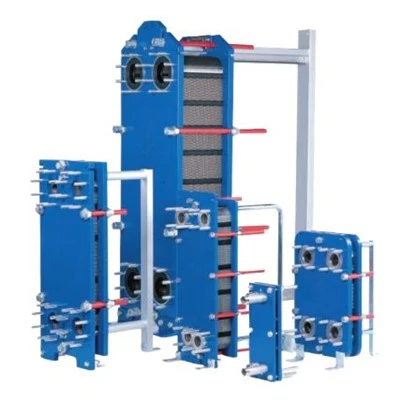
Funke FP04
Funke FP05
Funke FP08
Funke FP09
Funke FP10
 English


FUNKE FP Series · Independent Aftermarket Plates
We supply aftermarket replacement plate solutions for identified Funke gasketed plate heat exchanger configurations. Our historical model references include FP04, FP05, FP08, FP09, FP10, FP14, FP16, FP22, FP31, FP40, FP41, FP60, FP80 and FP205.
Matching a replacement Funke heat-transfer plate requires more than the model number. We review the pressed plate geometry, port configuration, plate thickness, material, gasket groove and position within the existing plate pack.
Stainless steel, titanium and selected special-alloy options can be evaluated according to the operating duty and confirmed supply specification. Send your exchanger nameplate, plate photographs or drawings for review.
Request Funke Plate Matching & Quote
Replacement plate reference for Funke gasketed plate heat exchangers.
Historical Funke replacement plate enquiries include FP-series model references used for gasketed plate heat exchangers. The identifiers below are starting points for technical matching, not confirmation that every configuration or material is in stock.
Funke FP04
Funke FP05
Funke FP08
Funke FP09
Funke FP10
Funke FP14
Funke FP16
Funke FP22
Funke FP31
Funke FP40
Funke FP41
Funke FP60
Funke FP80
Funke FP205
Funke FP numbers identify equipment or plate-family references, but they do not replace verification of the actual plate variant. Similar numbers may correspond to different outside dimensions, port locations, pressed patterns and sealing configurations.
For example, FP20 and FP205 are distinct model identifiers and must not be interpreted as the same plate. An FP series reference should also not be confused with a different FUNKE product series or a safety double-wall plate configuration.
Model matching: The 14 model identifiers above come from historical product records. Other FP and FPS references exist in wider industry catalogs, but an additional model should only become a confirmed product listing after its design and supply status have been checked.
A replacement plate must fit the installed frame and reproduce the correct flow-channel and gasket configuration. Similar appearance or overall dimensions alone cannot establish interchangeability.
Match overall length, width, hanging features and locating points.
Check opening diameter, port-center distances and punched or closed ports.
Verify corrugation geometry, flow-channel depth and contact-point arrangement.
Confirm sealing grooves, port-ring areas and gasket fixing features.
Identify orientation, channel arrangement and position in the plate pack.
Verify metal grade, sheet thickness and mechanical requirements.
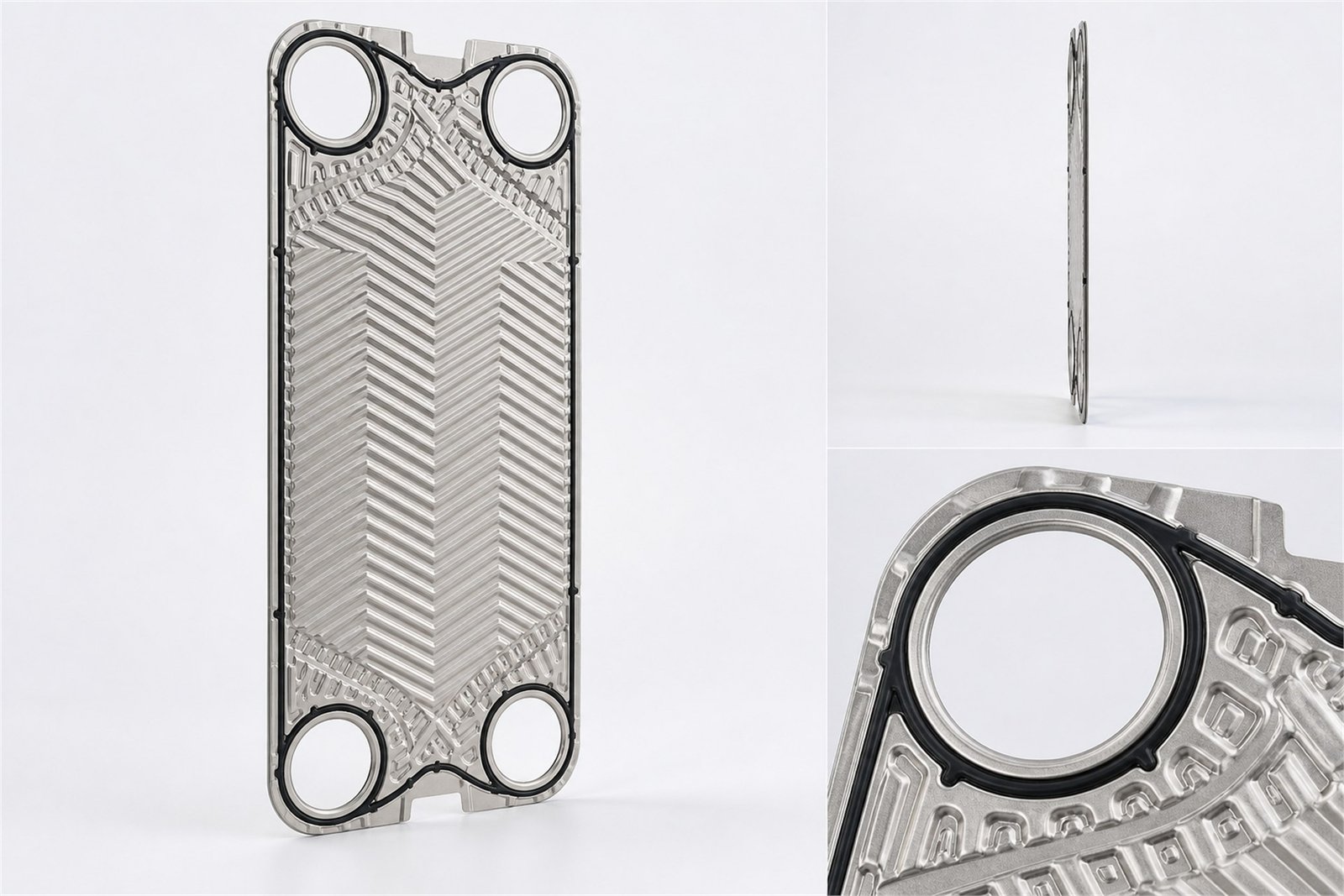
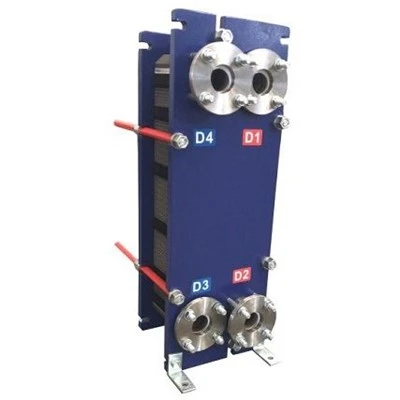
General plate geometry reference: ports, pressed channels and sealing features must be matched.
Dimensional identification: Overall plate length and width must not be confused with horizontal and vertical port-center spacing. Provide the units and measurement points for every dimension.
Heat-transfer plate materials must be selected according to both fluid circuits, process temperature, corrosion conditions and cleaning chemistry. The suitability of an alloy depends on the actual service environment rather than the model name.
| Material | Selection Consideration | Required Verification |
|---|---|---|
| AISI 304 / 304L | General industrial utility duties where the selected stainless steel is suitable. | Water chemistry, chloride exposure, temperature and cleaning agents. |
| AISI 316 / 316L | Process and utility duties requiring an appropriate molybdenum-bearing stainless steel. | Chlorides, pH, operating temperature, corrosion history and exact material grade. |
| Titanium | Considered for selected seawater and chloride-bearing cooling applications. | Titanium grade, fluid chemistry, temperature and mechanical compatibility. |
| Titanium-Palladium | Specialist titanium alloy reference for particular corrosion environments. | Exact alloy grade, process chemistry and plate manufacturing feasibility. |
| SMO254 | High-alloy stainless steel considered for selected demanding corrosion conditions. | Chloride concentration, fluid chemistry, grade and model availability. |
| Hastelloy C-276 | Nickel-alloy reference for certain aggressive industrial process fluids. | Chemical concentrations, temperature, specification and forming feasibility. |
Material availability: These material families are historical and technical references. Their inclusion does not mean that every grade is available for every Funke FP model. Exact plate material, geometry and production feasibility require confirmation before ordering.
The earlier replacement product information contained broad plate-family specification ranges. They are retained here for preliminary technical discussions only and are not certified values for any individual Funke model.
| Parameter | Historical Reference | Model-Specific Confirmation |
|---|---|---|
| Plate Thickness | 0.5 mm / 0.6 mm | Match the actual model, original material and pressure design. |
| Corrugation Depth | 3–5 mm | Verify the specific pressed channel profile. |
| Heat Transfer Area | 0.01–1.8 m² | Confirm the effective area for the exact plate design. |
| Port Diameter | DN30–DN450 | Confirm the nominal connection and actual plate openings. |
| Plate Dimensions | Model-dependent | Measure outside length, width and suspension geometry. |
| Port Center Spacing | HC / VC where defined | Record horizontal and vertical port-center distances separately. |
| Plate Pattern | Configuration-dependent | Verify embossing, channel orientation and flow arrangement. |
| Gasket Fixing | Model-dependent | Confirm clip, mechanical retention or adhesive design. |
Specification warning: The historical ranges above are not published as guaranteed Funke FP-series limits. A quotation should identify the actual plate dimensions, material grade, thickness and configuration.
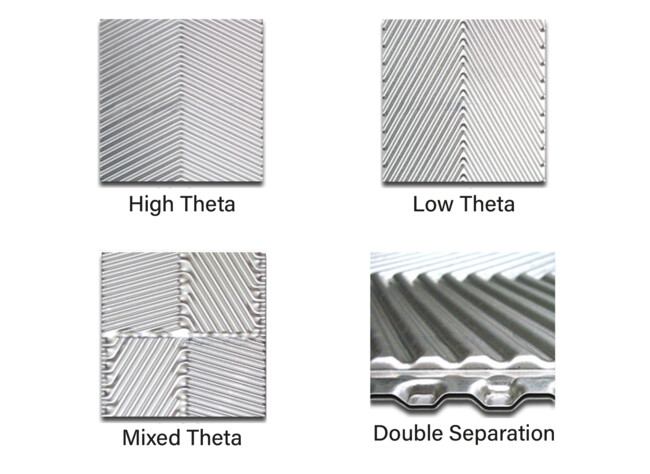
General reference showing pressed heat-transfer plate surfaces and channel patterns.
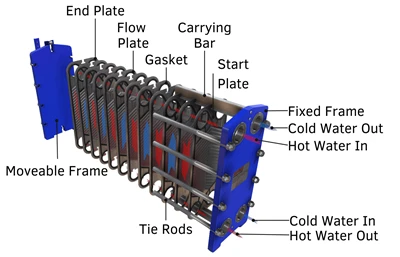
Gasketed plate heat exchangers use embossed metal plates arranged to form alternating flow passages. The pressed geometry affects heat-transfer intensity, fluid resistance, mechanical contact and flow distribution.
The angle, shape and depth of the pressed channels determine how the fluids move between neighboring plates. Different configurations can provide different combinations of thermal performance and pressure drop.
Certain original Funke designs use offset or asymmetric embossed channel configurations. When replacing such plates, the original geometry and specified arrangement must be identified rather than substituted with a generic corrugated plate.
Heat-transfer behavior depends on channel shape, flow rate, plate area, fluid properties and thermal conditions.
A replacement plate must preserve the intended channel geometry unless a revised design has been approved.
Greater flow disturbance may improve heat transfer in suitable designs but may also increase hydraulic resistance.
The existing pump capacity and allowable pressure drop should be considered before changing the plate arrangement.
Engineering note: Corrugation angle or the appearance of a plate does not establish interchangeability. Channel geometry, pressure drop, gasket design and plate-pack arrangement require verification.
A replacement heat-transfer plate must maintain the correct sealing interface. Funke gasketed plate designs may use mechanically retained or adhesive-mounted gaskets, depending on the model.
Clips, knobs or other retaining features may secure the gasket in its designated groove. The replacement plate must provide the matching features.
Where an adhesive gasket is specified, the sealing groove and installation method must match the original design. The adhesive and procedure require separate confirmation.
Different positions in a plate pack can require distinct port openings, sealing paths or gasket arrangements. Confirm the exact installed configuration.
A plate heat exchanger may use single-pass or multiple-pass flow arrangements. The installed plate sequence and port configuration determine the fluid paths and must be preserved when fitting replacement plates.
Certain equipment may also include double-sealing or safety features around port areas. If such features exist, they must be identified and reproduced in the appropriate replacement configuration.
Assembly warning: Never assume that an FP-series plate can replace a safety double-wall plate or a plate from another FUNKE series. Do not change port closures, plate orientation, gasket retention or the tightening dimension without approved technical instructions.
Metal plate forming produces the corrugated channels and contact features required by a plate heat exchanger. Geometry and surface condition are especially important when replacing individual plates within an existing pack.
The agreed replacement specification and any required inspection or material documents should be confirmed before order acceptance.
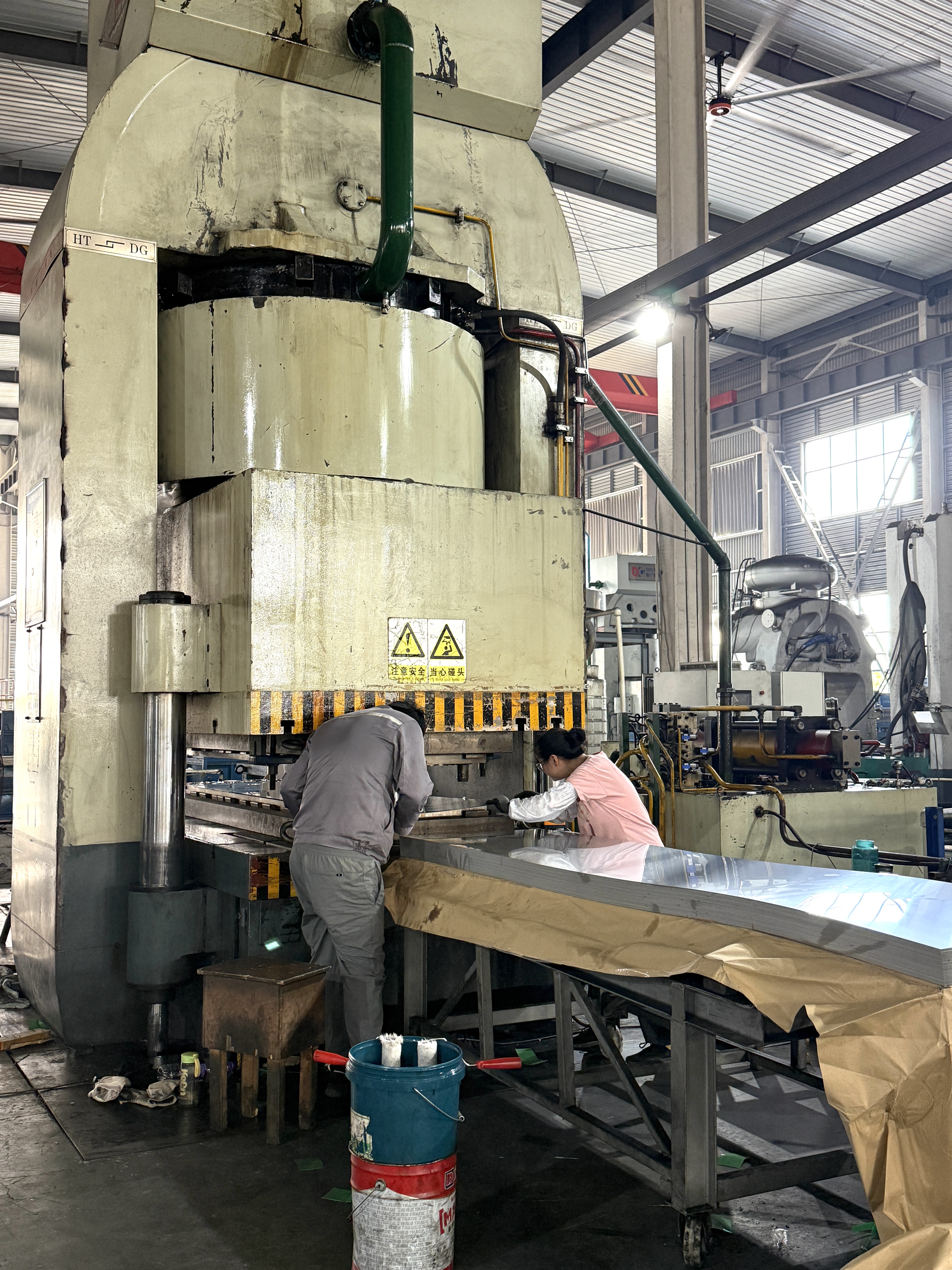
Industry manufacturing reference photo from CHENHE. This is not an image of our facilities.
Quality documentation: Material certificates, inspection reports and special testing must be confirmed for the specific order. General process illustrations do not establish a particular factory's certification, production capacity or testing results.
Poor thermal performance, pressure-drop changes and leakage do not always require new plates. The causes should be investigated to distinguish fouling, gasket failure, plate corrosion and mechanical damage.
Pitting or perforation may compromise separation between process fluids. Review material compatibility and the cause of corrosion before replacement.
Fatigue cracks, distorted ports, damaged pressed patterns or bent edges may prevent correct assembly and sealing.
A damaged groove or sealing surface can cause repeated leakage even after the rubber gasket is replaced.
Individual replacement may be considered when the damaged plate position is identified and the rest of the plate pack remains suitable for service.
A complete replacement pack may require evaluation when corrosion or mechanical deterioration affects multiple plates.
Maintenance caution: Removing plates changes the number of flow channels and may affect thermal performance, hydraulic resistance and mechanical assembly. Any change in plate quantity requires technical assessment.
FUNKE gasketed heat exchangers are used across a variety of industrial heating and cooling duties. Replacement plate selection depends on the specific equipment, operating conditions and material requirements.
Heating-water circuits, chilled-water systems and compatible glycol duties.
Machinery lubrication, hydraulic oil cooling and temperature-control duties.
Freshwater cooling, auxiliary equipment and selected seawater duties.
Heating and cooling of suitable chemicals with material review.
Auxiliary cooling and heat-recovery circuits in industrial plants.
Product and utility temperature control subject to hygiene needs.
Industrial process cooling, water heating and machinery temperature control.
Suitable geothermal, heat-recovery and other energy applications.
Record the Funke model, nameplate and original plate markings.
Check plate dimensions, port openings, pressing pattern and gasket groove.
Confirm material, thickness, operating duty and required plate positions.
Confirm the matching specification, quantity, documents and destination.
Are these genuine Funke heat exchanger plates?
No. These are independently supplied aftermarket replacement components intended for confirmed compatible Funke plate heat exchanger configurations. The Funke name is used for equipment identification and does not indicate an authorized original-manufacturer relationship.
Are Funke FP20 and FP205 replacement plates interchangeable?
Interchangeability must not be assumed. FP20 and FP205 are distinct model identifiers. The plate geometry, dimensions, port layout, sealing groove, material and installed configuration must be verified.
Can only one damaged Funke plate be replaced?
Individual replacement may be possible when the damaged plate position can be identified and the remaining pack is serviceable. The replacement must match the required geometry, port layout, alloy, thickness, orientation and gasket interface.
Can stainless steel Funke plates be replaced with titanium plates?
A material change requires review of the process fluids, corrosion conditions, operating temperature, mechanical requirements and gasket compatibility. Titanium is not an automatic substitute for every stainless steel application.
What gasket fixing methods are used on Funke heat exchanger plates?
Depending on the exact equipment design, gaskets may use mechanical retaining features or adhesive attachment. The replacement plate groove and gasket fixing method must match the installed system.
Can Funke replacement plates and matching gaskets be ordered together?
Yes. Replacement plate and gasket requirements can be reviewed together. Provide the full model, gasket profile, fixing method, required compound, operating fluids and quantities. Supply details are confirmed during quotation.
What information is needed for a Funke replacement plate quotation?
Provide the complete equipment model, nameplate, plate markings, photographs, overall dimensions, port sizes, alloy, thickness, plate configuration, operating conditions, quantity and destination. A drawing or original sample may be needed for uncertain model variants.
Please provide the complete Funke FP model, nameplate and plate photographs, dimensions, port arrangement, material, thickness, gasket configuration, operating conditions, required quantities and destination country.
If matching replacement gaskets are also needed, include the gasket material, attachment method and required quantity.
As one of the most professional funke plate manufacturers and suppliers in China, we have world-leading production equipment and strong manufacturing capabilities. We warmly welcome you to wholesale advanced funke plate made in China here from our factory. Customized orders are welcome.