High-theta and low-theta plates describe different chevron-channel characteristics in gasketed plate heat exchangers. In general, a more thermally aggressive pattern creates stronger flow disturbance and higher pressure drop, while a lower-resistance pattern favors hydraulic performance. Neither configuration is automatically better for every operating duty.

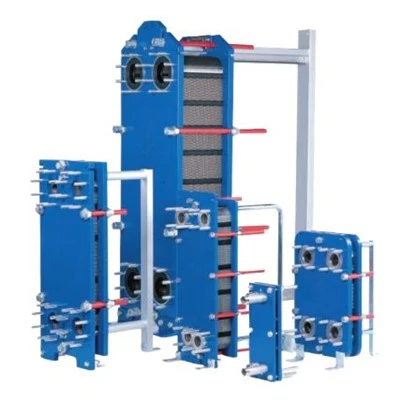
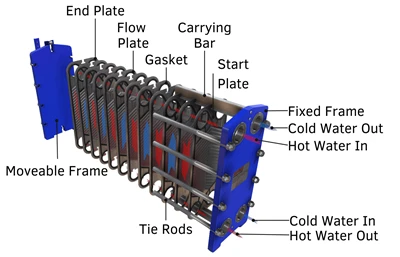
General corrugated heat-transfer plate reference. The photograph does not establish a specific high-theta or low-theta variant.
What Does Chevron Angle Mean in a Plate Heat Exchanger?
Pressed chevron corrugations form narrow flow passages between adjacent plates. Their angle, depth, spacing and orientation influence fluid motion, heat transfer and mechanical contact within the compressed plate pack.
Chevron angle terminology is not completely uniform across manufacturers. Some references describe the angle relative to a horizontal axis; others use a different reference. Therefore, a numerical angle alone is not a reliable way to identify an interchangeable replacement plate.
For an existing exchanger, the original plate drawing, pattern code and plate arrangement take priority over a generic high-theta or low-theta label.
High Theta vs Low Theta: Thermal and Hydraulic Comparison
| Selection Factor | High-Theta Configuration | Low-Theta Configuration |
|---|---|---|
| Flow disturbance | Generally stronger for comparable conditions. | Generally less intense flow disturbance. |
| Heat transfer | Can provide higher heat-transfer intensity. | May provide lower intensity with reduced resistance. |
| Pressure drop | Generally higher hydraulic resistance. | Generally lower hydraulic resistance. |
| Selection emphasis | Thermal performance within an acceptable pressure-drop budget. | Lower pressure loss while still meeting the heat-transfer duty. |
| Replacement decision | Must match original geometry or an approved redesign. | Must match original geometry or an approved redesign. |
Important: These are general engineering tendencies, not guaranteed numerical performance differences. Actual results depend on plate geometry, flow rate, viscosity, fluid properties, channel count and arrangement.
When Might Each Plate Pattern Be Considered?
Stronger Heat-Transfer Requirement
A higher-resistance plate pattern may be evaluated where additional thermal performance is required and the available pumping pressure is sufficient.
The engineer must still confirm approach temperatures, available area, flow rate and pressure-drop limits before choosing the pattern.
Pressure-Drop-Limited Circuit
A lower-resistance pattern may be considered where the process flow is high or the circulation system has a strict allowable pressure-drop limit.
A lower pressure drop is not useful if the exchanger consequently fails to achieve the required outlet temperature.
A mixed plate arrangement may be used in certain exchanger designs to balance thermal performance and hydraulic loss. Such configurations must follow the approved thermal design, channel combination and plate sequence.
Why You Should Not Change Chevron Plates During Maintenance
Maintenance teams sometimes discover two plates with similar outside dimensions but visibly different corrugations. Installing the wrong profile can create incorrect contact points or alter the original fluid passage.
- Pressing pattern: confirm channel geometry and corrugation orientation.
- Port arrangement: match open and closed port positions.
- Gasket groove: ensure the specified gasket can seat correctly.
- Plate sequence: preserve the required high/low or mixed configuration.
- Hydraulic design: check allowable pressure drop before any redesign.
Changing one plate can affect more than local heat transfer. Replacements must fit mechanically and preserve the intended assembled configuration.
Information Required to Confirm a Replacement Chevron Plate
- Full exchanger brand, model and serial information.
- Nameplate and plate-marking photographs.
- Pictures of both plate faces, corrugation and gasket groove.
- Plate length, width, port diameter and center distances.
- Plate alloy, thickness, position and required quantity.
- Hot-side and cold-side fluids, flow rates, temperatures and operating pressures.
- Maximum allowable pressure drop on each side.
For additional product selection, explore our heat exchanger plates , GEA replacement plates and Tranter replacement plates .
High Theta and Low Theta FAQ
Does high theta always mean better heat transfer?
Not always. Higher flow disturbance may improve heat transfer but also increase pressure drop. The complete duty, fluid properties and channel geometry must be evaluated together.
Can high-theta plates be replaced with low-theta plates?
Do not assume interchangeability. A different pressed pattern may change mechanical contact, fluid resistance and heat-transfer performance. Any substitution requires model-specific engineering review.
Is the chevron angle enough to identify a replacement plate?
No. Plate dimensions, pressing geometry, port openings, gasket groove, material and installed position also require verification.
What is the most important hydraulic selection input?
The allowable pressure drop is essential, together with fluid flow rate, properties and the required thermal duty. Both circuits should be evaluated.
Request Chevron Plate Matching or Technical Selection Support
Send the original plate model, photos, corrugation details, flow rates, operating temperatures, allowable pressure drop and quantity. We can review the replacement specification before quotation.
Submit Plate Details