


Plate Heat Exchangers for Refrigeration, Chilled Water & Glycol Systems
Refrigeration systems require stable heat transfer across changing operating loads while controlling temperature approach, pressure drop, freezing risk and fluid compatibility.
WTSML supplies complete plate heat exchangers, replacement heat-transfer plates and compatible gaskets for chilled-water, glycol, cooling, condensing, evaporation and heat-recovery duties.
Where Are Plate Heat Exchangers Used in Refrigeration Systems?
Plate heat exchangers can transfer heat between refrigeration, chilled-water, glycol and process-fluid circuits while keeping the media hydraulically separated.
Transfer cooling between independent water circuits or isolate a chiller from secondary water quality and pressure conditions.
Separate glycol loops from water or process circuits where lower temperature or freeze protection is required.
Support evaporation duties where exchanger configuration and materials suit the actual medium and operating conditions.
Transfer rejected heat to cooling water or a useful heat-recovery circuit when operating conditions allow.
Common Refrigeration Plate Heat Exchanger Applications
Chilled-Water Systems
Hydraulically isolate chilled-water circuits, protect chillers from unsuitable water quality and transfer cooling to secondary building or process loops.
- Chilled water / secondary water
- Process cooling loops
- Cooling-tower separation
- Equipment protection
Glycol Cooling
Glycol solutions are commonly used where lower operating temperature or freeze protection is required.
- Glycol / water heat exchange
- Low-temperature circulation
- Cold-storage secondary loops
- Process refrigeration
Heat Recovery
Waste heat from refrigeration can be transferred to another water or process circuit when the available temperature makes useful recovery practical.
- Hot-water preheating
- Process-water heating
- Condenser heat recovery
- Energy reuse
Five Factors That Directly Affect Refrigeration PHE Performance
Close temperature approaches require accurate thermal selection and suitable plate configuration.
Low temperature and insufficient flow can create locally colder areas and freezing risk.
Higher velocity may improve turbulence while increasing hydraulic resistance.
Plate and gasket materials must match the actual water, glycol or process medium.
Refrigeration systems may operate under different seasonal and process loads.
Counterflow Helps Use the Available Temperature Difference
Under comparable conditions, counterflow generally provides a larger logarithmic mean temperature difference than parallel flow.
Hot-Side Inlet
The higher-temperature medium enters the exchanger.
Plate Channels
Corrugated plates create alternating channels and promote heat transfer.
Cold-Side Flow
The colder medium flows in the opposite direction in a counterflow arrangement.
Controlled Outlet
Required outlet temperatures depend on flow, duty and exchanger configuration.
Information Required for Refrigeration Heat Exchanger Selection
Water, glycol, refrigerant or process medium.
Water, glycol, refrigerant or another cooling medium.
Provide both-side flow rates with clear units.
Provide inlet and required outlet temperatures or relevant phase-change conditions.
Provide operating and design pressure on both sides.
State the maximum acceptable hydraulic resistance.
Concentration affects viscosity, thermal properties and freeze protection.
Required for freezing-risk and gasket/material review.
Select Materials According to the Actual Refrigeration Medium
| Selection Item | Information to Confirm | Why It Matters |
|---|---|---|
| Plate Material | Fluid chemistry, chlorides, temperature and cleaning conditions | These factors determine corrosion risk and suitable alloy direction. |
| Gasket Compound | Medium, minimum / maximum temperature, pressure and chemical compatibility | Incorrect gasket material may harden, swell, leak or lose sealing performance. |
| Plate Geometry | Flow rate, heat duty and allowable pressure drop | Corrugation and channel geometry influence both heat transfer and pressure loss. |
| Plate Quantity | Heat duty, temperature approach and flow arrangement | Plate-pack configuration should follow actual operating data. |
Reduce Freezing and Unstable-Operation Risk
Abnormally low flow can create colder local conditions.
Concentration should match the minimum expected operating temperature.
Temperature trends help identify abnormal load and flow conditions.
Fouling and debris reduce flow area and can create uneven heat transfer.
Keep the Refrigeration PHE Operating as Designed
Installation Considerations
- Confirm hot-side and cold-side connection arrangement.
- Avoid unnecessary piping pressure loss.
- Remove trapped air from water and glycol circuits.
- Allow sufficient space for plate-pack maintenance.
- Evaluate filtration when water contains particles.
- Verify pump and control-valve operation over the expected load range.
Maintenance Considerations
- Monitor temperature approach and pressure drop.
- Inspect for fouling, deposits and channel blockage.
- Inspect gaskets for aging, deformation and leakage.
- Inspect plates for corrosion, cracks or damage.
- Check glycol concentration and fluid condition.
- Clean according to actual fluid quality and fouling tendency.
Three Core Plate Heat Exchanger Product Groups
Refrigeration applications are supported through complete plate heat exchangers, replacement heat-transfer plates and replacement gaskets.
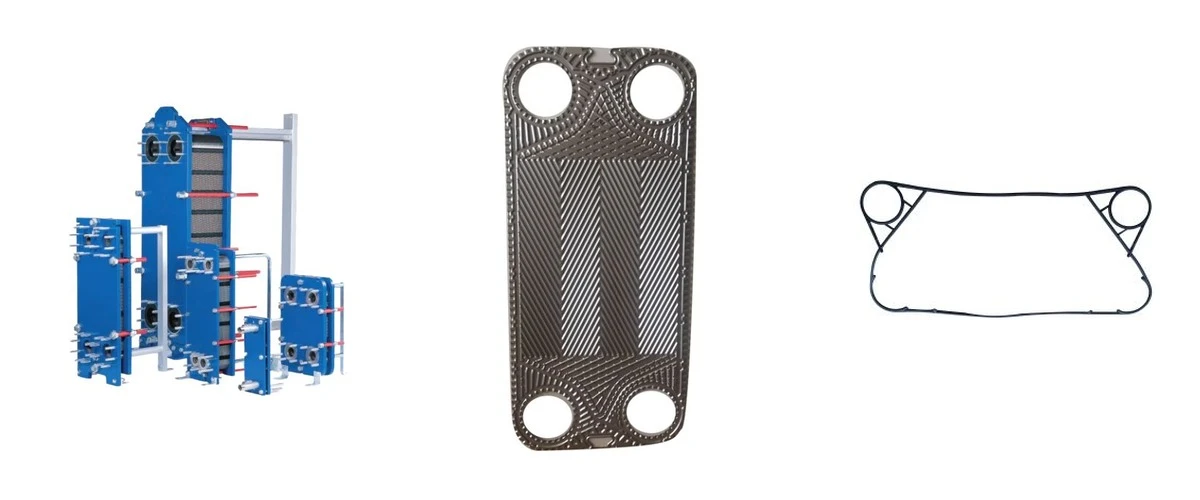
Complete Plate Heat Exchangers
Complete units selected according to thermal duty, flow rate, temperature program, pressure conditions and allowable pressure drop.
View Plate Heat Exchangers →Heat Exchanger Plates
Replacement or new-project plates selected according to exchanger model, plate geometry, material and operating conditions.
View Heat Exchanger Plates →Heat Exchanger Gaskets
Replacement gaskets matched according to exchanger model, sealing profile, actual medium, temperature and pressure.
View Heat Exchanger Gaskets →Replacing Plates or Gaskets in an Existing Refrigeration PHE
Existing equipment data should be verified before replacement components are confirmed.
Provide the existing exchanger manufacturer and full model.
Send a clear equipment nameplate photo.
Clear component photos support geometry and profile identification.
Include dimensions, existing material and required quantity.
From Refrigeration Duty Data to Product Selection
For new projects, provide both media, flow rates, temperatures, operating pressure, allowable pressure drop and minimum operating temperature. For replacement projects, also send the existing exchanger model, nameplate and component photos.
Prepare These Details Before Requesting a Quote
Cooling, glycol, evaporation, condensation or heat recovery.
Water, glycol, refrigerant or process fluid.
Water, glycol, refrigerant or other medium.
Both-side flow rates with clear units.
Inlet and required outlet conditions.
Working and design pressure.
Maximum allowable pressure drop.
Provide concentration when applicable.
Brand and model for replacement requirements.
Required quantity and destination country.
Common Refrigeration Plate Heat Exchanger Questions
Provide both media, flow rates, inlet and required outlet temperatures, operating pressure, allowable pressure drop and minimum operating temperature.
Yes. Glycol concentration, operating temperature, flow rate and viscosity should be included because they affect both thermal and hydraulic performance.
Under comparable conditions, counterflow generally provides a larger logarithmic mean temperature difference than parallel flow.
Maintain adequate flow, use appropriate freeze protection where required, monitor temperature conditions and prevent channel blockage or abnormal low-flow operation.
Selection should consider the exchanger model, gasket profile, actual medium, minimum and maximum temperature, operating pressure and chemical compatibility.
Possible causes include excessive flow, increased fluid viscosity, fouling, blocked channels or a plate configuration that does not match the actual duty.
Send Your Refrigeration Data for Technical Review
Please provide both media, flow rates, inlet and outlet temperatures, working pressure, allowable pressure drop and minimum operating temperature. For replacement projects, include the existing brand, model, nameplate and component photos.
Request Refrigeration Technical Support →Refrigeration Plate Heat Exchanger Inquiry
Send your project or replacement information for review of a complete plate heat exchanger, replacement plate or compatible gasket.