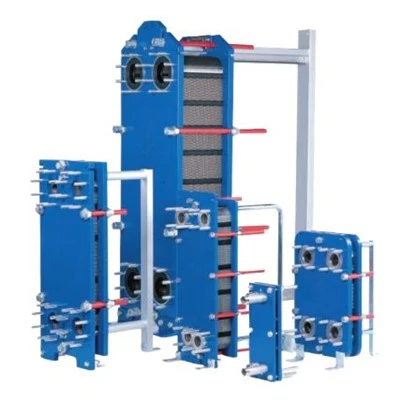
GEA VT Series
GEA VT04
GEA VT10
GEA VT20
GEA VT40
GEA VT80
 English


GEA Replacement Plates · Independent Aftermarket
We review aftermarket replacement plate requirements for identified GEA gasketed plate heat exchangers, including VT and NT model families. Matching covers the original plate geometry, chevron pattern, port layout, gasket groove, material and installed position.
Stainless steel, titanium and selected special-alloy options can be evaluated against the actual fluid and operating duty. We support enquiries for individual damaged plates and complete replacement plate packs, subject to model and supply confirmation.
Request GEA Plate Matching & Quote
Reference plate for identification of replacement heat exchanger components.
Historical GEA replacement plate records cover VT and NT heat exchanger model families. The names below help identify replacement enquiries, while actual plate dimensions, pressed patterns, gasket interfaces and available material combinations must be confirmed for each order.
GEA VT04
GEA VT10
GEA VT20
GEA VT40
GEA VT80
GEA NT100T
GEA NT100M
GEA NT100X
GEA NT150S
GEA NT150L
GEA NT250S
GEA NT250L
The wider product identification database also includes VT205, VT40M, VT405, NT50T, NT50M, NT50X, NT250M, NT350S, NT350M, N40 and FA184. These references require individual verification before a compatible replacement can be specified.
Model variation: VT40 and VT40M, or NT100T, NT100M and NT100X, must not be assumed interchangeable. Full model designations, plate geometry, flow arrangement and sealing features are required for matching. A model appearing in historical records does not confirm current stock or production capability.
A replacement heat-transfer plate must fit the installed exchanger frame and reproduce the required channel and sealing configuration. Similar overall dimensions alone do not establish compatibility.
Check overall length, width, hanging features and support geometry.
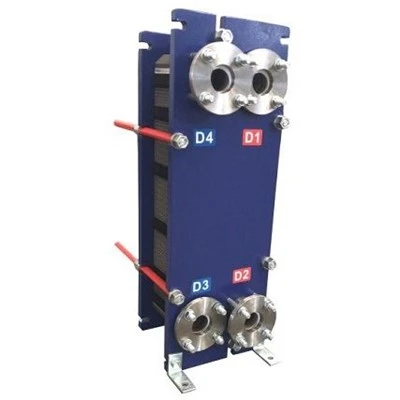
Confirm port openings, closed ports and horizontal / vertical port-center distances.
Match the pressed corrugation geometry, direction and channel depth.
Verify sealing grooves, port-ring areas and gasket retention features.
Identify left/right orientation and the position in the plate pack.
Confirm metal grade, sheet thickness and operating requirements.
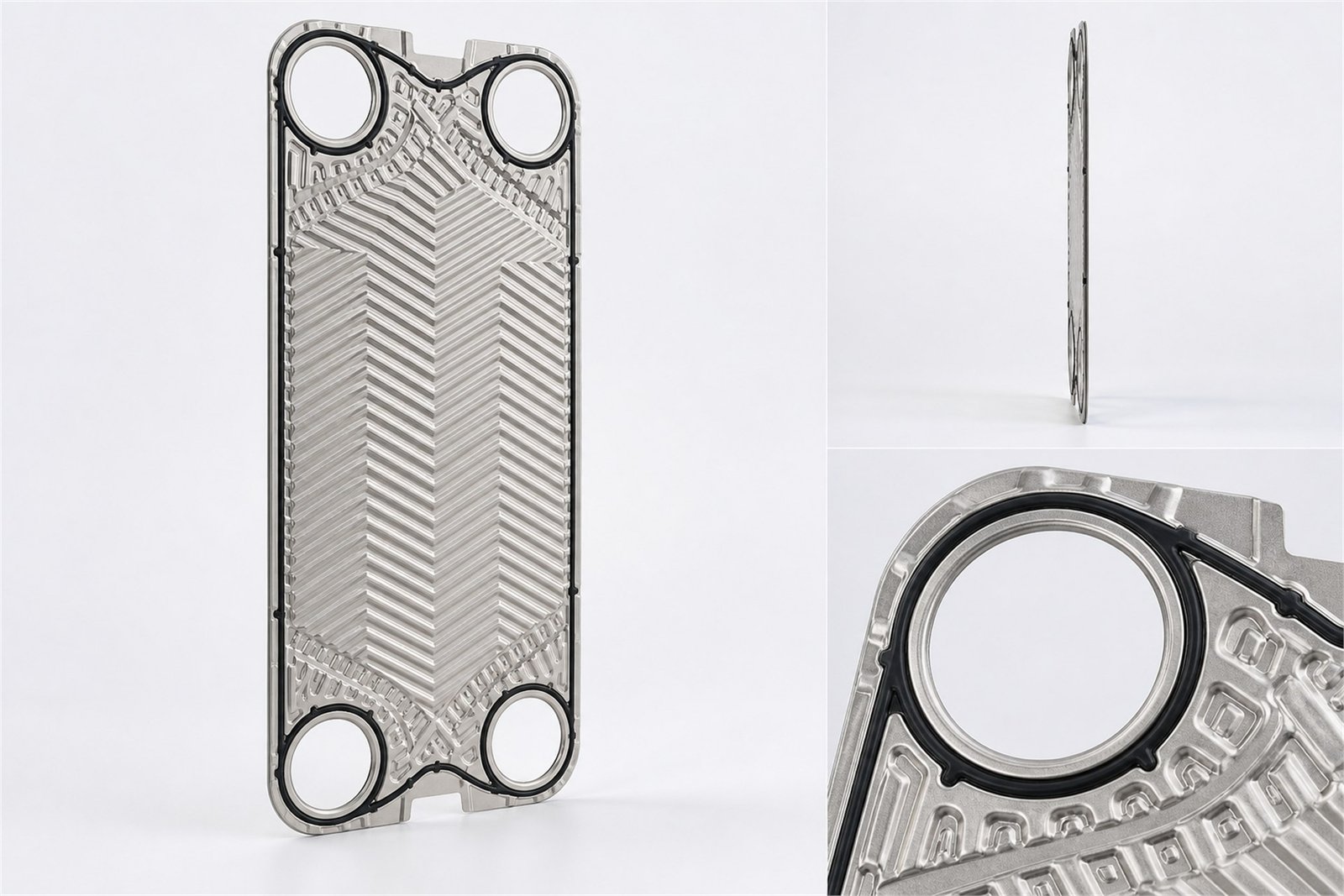
Plate geometry and port arrangements must be checked before replacement.
Measurement: Overall length and width are different from HC and VC port-center measurements. Provide dimensions with units, measurement points and photographs.
The pressing angle and geometry of a chevron plate influence turbulence, pressure drop and heat-transfer performance. Adjacent corrugated plates create flow channels and contact points that contribute to the mechanical behavior of the assembled plate pack.
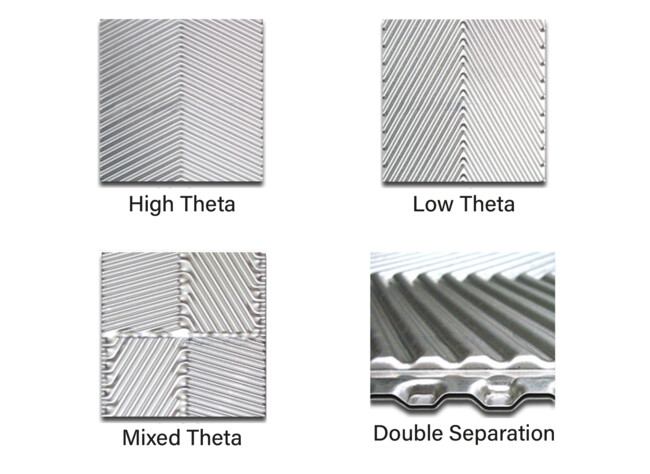
Pressed chevron patterns influence heat transfer and hydraulic resistance.
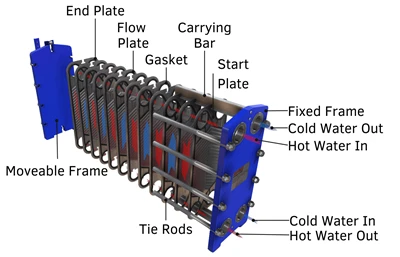
Hot and cold media pass through separate channels formed by neighboring plates. The corrugated metal surface separates the streams while transferring thermal energy between them.
The plate pattern affects channel velocity, mixing behavior and resistance to flow. The preferred geometry depends on the process fluid, allowable pressure drop and required heat-transfer duty.
In common chevron classifications, high-theta plate arrangements generally encourage stronger flow disturbance and heat transfer, often with higher pressure drop.
Low-theta arrangements generally favor lower flow resistance in comparable channel conditions. Actual efficiency still depends on the full exchanger design.
Engineering distinction: The relationship between the named theta angle and actual chevron geometry depends on the angle measurement convention. Do not substitute one pressing pattern for another without evaluating the complete heat-transfer and hydraulic design.
The installed port pattern and plate orientation determine how the hot and cold media enter and leave their designated channels. Replacement plates must follow the equipment's actual flow diagram.
In a single-side flow arrangement, a fluid may enter and leave through ports located on the same side of the plate layout. The actual inlet and outlet configuration depends on the exchanger design.
Some applicable plate patterns allow orientation changes using the same pressing, but this must be verified for the exact model.
In diagonal flow arrangements, the selected inlet and outlet ports are positioned diagonally. Different plate handedness or port-opening configurations may be required.
The correct plate sequence, orientation and gasket layout must be maintained during refurbishment or replacement.
Assembly warning: A right-hand plate cannot universally be converted into a left-hand plate simply by turning it upside down. This may be possible for certain designs, but not all models or diagonal-flow arrangements. Follow the actual plate arrangement drawing and port configuration.
The plate material must be evaluated against both process streams, fluid concentration, temperature, cleaning chemicals and operating history. Historical alloy references do not establish availability for every GEA model.
| Material | Selection Context | Required Verification |
|---|---|---|
| AISI 304 / 304L | Industrial utility and water applications where the alloy offers suitable corrosion resistance. | Fluid chemistry, chlorides, temperature and cleaning agents. |
| AISI 316 / 316L | Process and water applications requiring a suitable molybdenum-bearing stainless steel. | Chloride concentration, pH, corrosion history and temperature. |
| Titanium | Selected seawater and chloride-bearing duties where the exact grade is suitable. | Water chemistry, alloy grade, operating conditions and plate model compatibility. |
| Titanium-Palladium | Specialist titanium alloy for particular corrosion conditions. | Exact chemical environment, material specification and manufacturing feasibility. |
| SMO254 | High-alloy stainless steel reference for selected demanding corrosion applications. | Corrosion requirements, exact grade and model availability. |
| Hastelloy C-276 | Nickel-alloy reference for selected chemically aggressive process duties. | Chemical concentrations, temperature, material grade and plate-forming feasibility. |
Material review: An alternative alloy requires engineering assessment. Chemical compatibility alone does not establish mechanical or plate-pack interchangeability.
The earlier product catalog provided broad plate-family ranges. These figures are historical references only. They are not certified specifications for an individual GEA VT or NT plate.
| Parameter | Historical Reference | Required Confirmation |
|---|---|---|
| Plate Thickness | 0.5 mm / 0.6 mm | Original material and model-specific plate thickness. |
| Corrugation Depth | 3–5 mm | Exact channel geometry and pressing pattern. |
| Heat Transfer Area | 0.01–1.8 m² | Effective plate area for the selected model and design. |
| Port Diameter | DN30–DN450 | Actual port opening dimensions and nominal size. |
| Plate Length / Width | Model-specific | Overall dimensions, support and hanging features. |
| Port Centers | HC / VC where defined | Horizontal and vertical port-center spacing. |
| Plate Type | Configuration-dependent | Chevron pattern, handedness, port closures and plate position. |
| Gasket Interface | Model-dependent | Sealing groove, retaining design and gasket compound. |
Individual plate replacement may be possible where the damaged plate position is known and the remaining plate pack is suitable for continued operation.
For widespread corrosion, repeated mechanical failures or extensive refurbishment, a complete replacement plate pack may require evaluation.
Replacing a plate does not automatically resolve a leak caused by incorrect gasket seating, excessive pressure, frame distortion or unsuitable tightening.
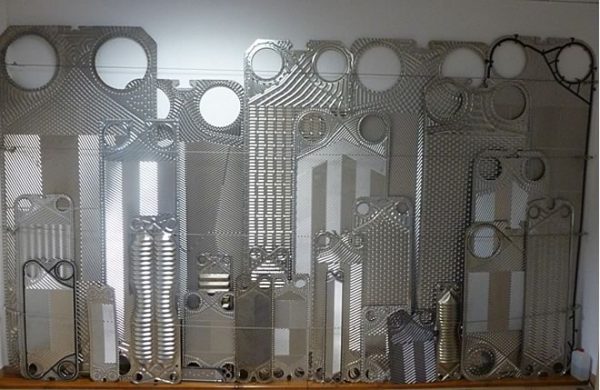
Replacement plate components for industrial PHE servicing.
Plate-pack safety: The plate count, assembly sequence, flow layout and frame closing dimension are equipment-specific. Do not change these settings without approved technical instructions.
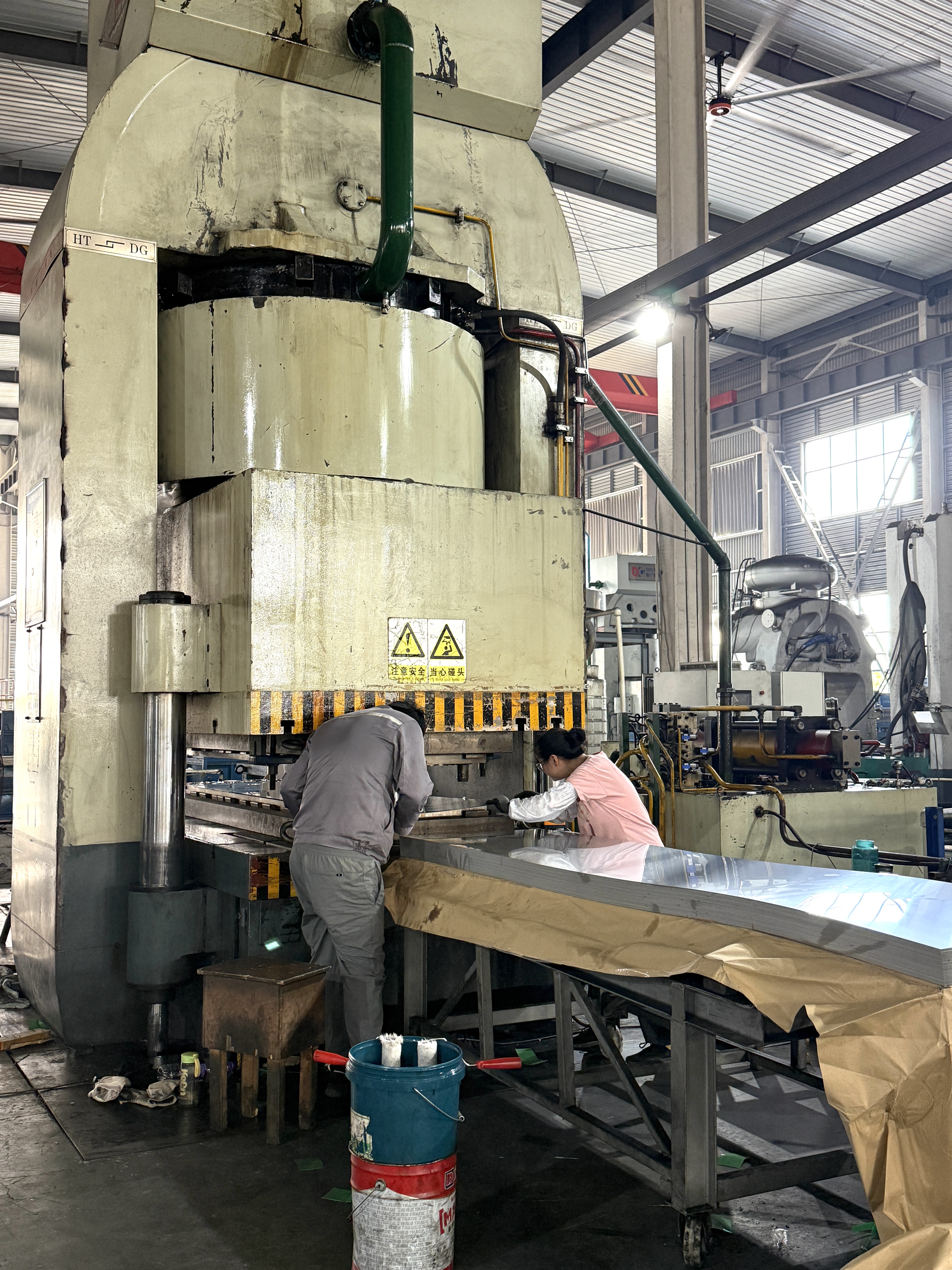
Industrial plate press-forming process reference.
Press forming creates the corrugated channels and contact features of a metal heat-transfer plate. Proper geometry is important for assembly, sealing and flow distribution.
Applicable inspection procedures, material documentation and other agreed quality records should be confirmed with the order specification.
Process evidence: General forming-process photographs illustrate the manufacturing method. They do not establish that a particular GEA replacement model has been tested or manufactured using the equipment shown.
GEA gasketed plate exchangers may be encountered in heating, cooling and process utility applications. The required replacement material, channel design and gasket selection depend on the actual duty.
Water-to-water heating, chilled-water and compatible glycol circuits.
Freshwater and oil cooling, with special consideration for seawater corrosion.
Product cooling, heating and utility services with suitable hygiene requirements.
Process heating and cooling requiring fluid compatibility and corrosion assessment.
Auxiliary cooling and compatible industrial heat-recovery applications.
Suitable secondary cooling and temperature-control circuits.
Process-water cooling and machinery temperature control.
Compatible utility duties subject to material and cleanliness requirements.
Identify the full GEA exchanger model and plate markings.
Check dimensions, ports, corrugation and sealing groove.
Confirm material, thickness and both process fluid conditions.
Confirm plate quantity, gasket requirements, documents and destination.
Are these original GEA heat exchanger plates?
No. These are independently supplied aftermarket replacement components for identified compatible configurations. GEA is used for equipment identification and does not imply an authorized original-manufacturer relationship.
Are GEA VT40 and VT40M plates interchangeable?
Interchangeability must not be assumed. The full designation, plate geometry, ports, gasket groove, material and installed plate arrangement require verification before replacement.
What is the difference between high-theta and low-theta GEA plate patterns?
In common chevron terminology, high-theta configurations generally increase flow disturbance and pressure drop, while low-theta configurations generally provide lower hydraulic resistance. Actual results depend on channel geometry, angle convention and operating conditions.
Can a right-hand GEA plate be used as a left-hand plate?
Only where the exact plate design and port arrangement permit it. Some single-side-flow constructions may allow rotation, but diagonal-flow and other configurations may require distinct plate types. Follow the original plate arrangement drawing.
Can one damaged GEA heat exchanger plate be replaced separately?
Individual replacement may be possible when the affected plate position can be identified and the remaining plate pack is serviceable. Geometry, material, port layout, orientation and gasket compatibility must match.
Can titanium replace a stainless steel GEA heat exchanger plate?
A material change requires technical review of fluid chemistry, corrosion conditions, temperature, mechanical design and gasket compatibility. Titanium is not automatically suitable for every stainless steel application.
Can GEA replacement plates and matching gaskets be ordered together?
Yes. Plate and gasket requirements can be reviewed together. Provide the exchanger model, plate groove, gasket attachment design, fluids, temperature, pressure and required quantities.
What information is required for a GEA replacement plate quote?
Send the full model, nameplate, plate photos, markings, dimensions, alloy, thickness, flow arrangement, gasket requirements, operating conditions, quantities and destination country. Drawings or samples may be needed for uncertain legacy variants.
Please include your complete GEA VT or NT model, nameplate and plate photographs, dimensions, material, thickness, port layout, operating conditions, required quantities and destination country. Add matching gasket requirements and documentation needs where applicable.
As one of the most professional gea plate manufacturers and suppliers in China, we have world-leading production equipment and strong manufacturing capabilities. We warmly welcome you to wholesale advanced gea plate made in China here from our factory. Customized orders are welcome.
heating transfer replacement