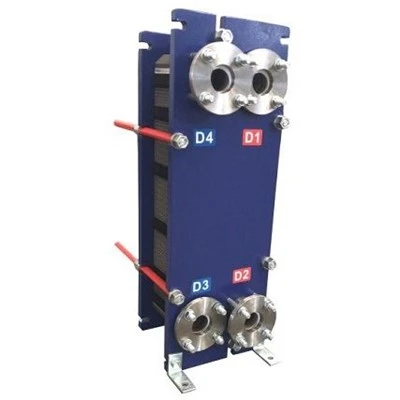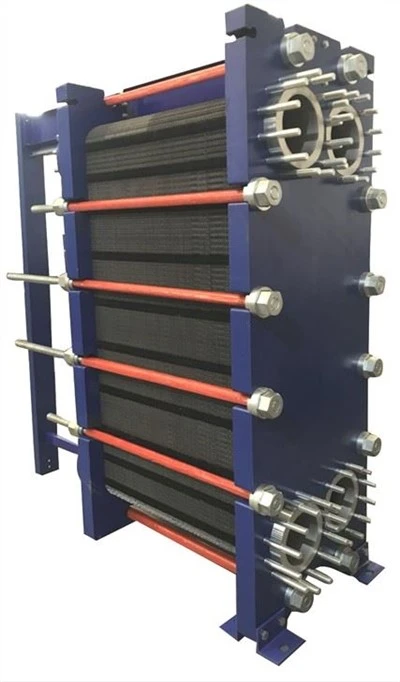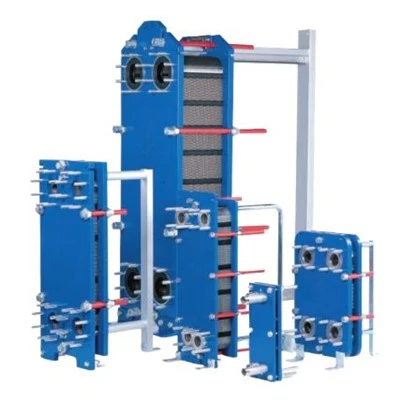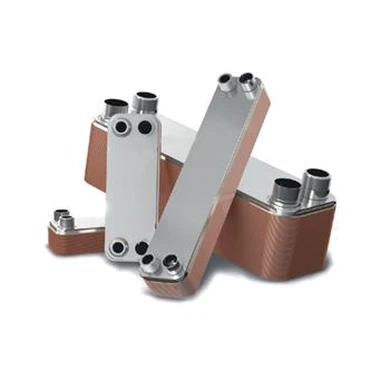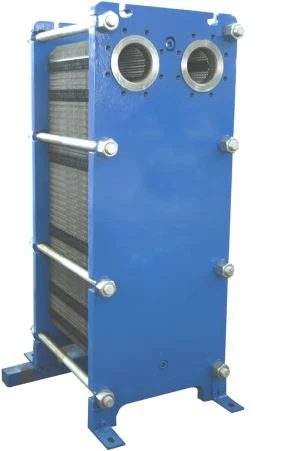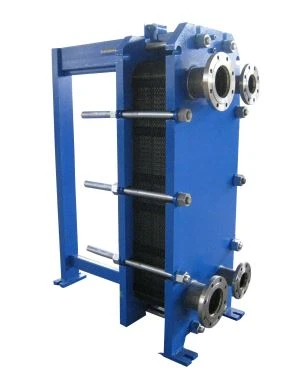
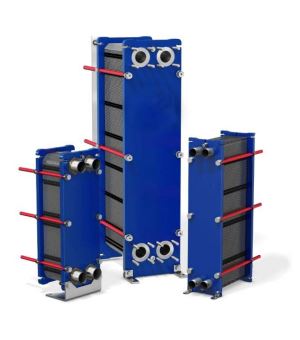
WTSML industrial gasketed plate heat exchanger product reference.
Counterflow Plate Heat Exchanger for Controlled Water Temperatures
Industrial water systems sometimes require a heating or cooling outlet temperature that approaches the temperature of the opposing fluid stream. Flow direction becomes a significant part of the exchanger selection.
This equipment configuration uses gasketed metal plates to establish separate water circuits. For countercurrent service, the two streams move through adjacent channels in opposing directions.
WTSML can review suitable gasketed plate-and-frame equipment against the customer's water quality, temperature program, flow range and installation constraints.

Engineering illustration: gasketed plate pack and support assembly. Source: Savree.
What Is Inside the Plate-and-Frame Assembly?
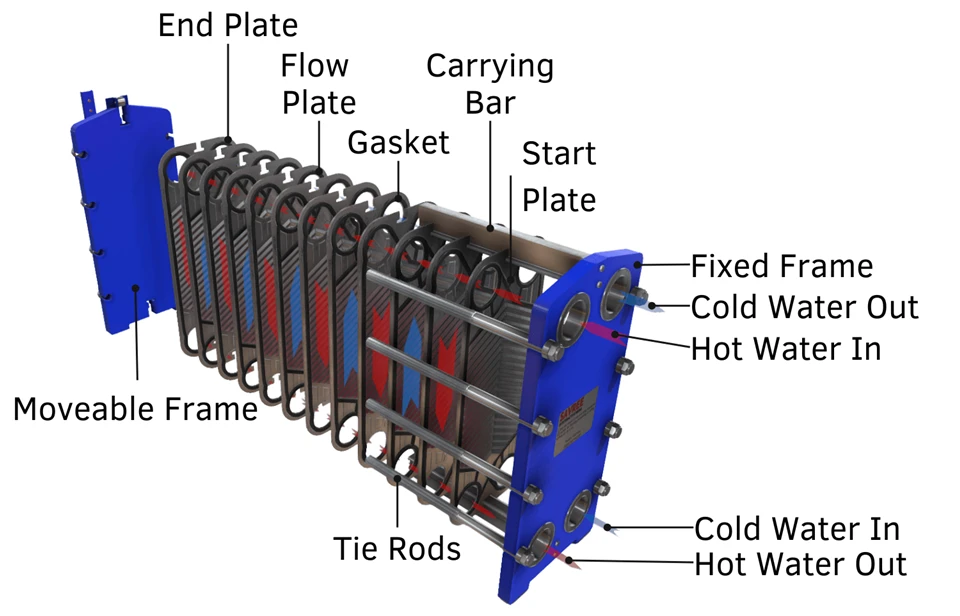
The exploded illustration shows how individual heat-transfer plates sit between the structural end members of a gasketed exchanger.
The plates are positioned on a supporting arrangement and compressed into a sealed package. The design allows the plate assembly to be accessed for approved maintenance operations.
For water-system projects, a buyer should distinguish between the complete frame dimensions and the available space needed to maintain the plate pack.
Frame Members, Plate Supports and Compression Hardware
In a typical demountable design, the frame includes a stationary end, a movable pressure plate, carrying and guiding members and tightening bolts.
The structural components must maintain the required plate alignment and compression. Their dimensions and load limits vary according to the equipment model.
When replacing a unit, the buyer should check connection positions, frame accessibility and the support requirements of the new equipment.
Component identification illustration supplied from Savree.

Illustration of alternating hot- and cold-fluid passages. Source: Savree.
How the Gaskets Direct the Two Circuits
The colored flow-path diagram highlights a central feature of gasketed plate equipment: adjacent channels carry different fluid streams.
Port openings and gasket arrangements govern which channels receive each stream. Heat passes across the separating metal surfaces while the fluids remain in their designated passages during normal operation.
The channel sequence and connection configuration must match the original engineering design. Incorrect plate arrangement can disrupt the intended routing.
Countercurrent, Parallel and Crossflow Compared
Fluid direction is an important part of thermal design because it affects how the temperature difference develops through the equipment.

Flow direction concepts: parallel, counter and cross. Source: Savree.
Why Counterflow Is Relevant to Water Heat Recovery
In parallel flow, the streams travel in the same general direction. In counterflow, the hot and cold streams travel in opposite directions.
Crossflow describes streams moving across one another. Not every one of these arrangements is available in every gasketed plate-and-frame model.
A suitable countercurrent configuration can support a demanding temperature approach, provided the plate arrangement and available heat-transfer area meet the design.
Parallel Flow
Both streams progress in the same direction. The temperature difference typically changes substantially along the path.
Counterflow
Streams travel oppositely, providing a useful temperature relationship for many liquid-to-liquid duties.
Crossflow
Flow directions intersect. Its use depends on the specific heat exchanger construction and process design.
Why Plate Sequence Must Be Recorded During Maintenance
Some plate-pack maintenance procedures use a diagonal reference line across the assembled plates. This assists with identifying the original order during dismantling and reassembly.
The marking is a reference method, not a substitute for plate identification, manufacturer documentation or the prescribed tightening dimension.
For equipment reused in water-based systems, correct sealing paths are essential to preserve separate circuits after servicing.

Diagonal plate-pack identification marking illustration. Source: Savree.

Single-pass and multi-pass arrangement reference. Source: Savree.
Selecting the Number of Fluid Passes
A single-pass arrangement carries a stream through one configured pass of the plate pack. Multi-pass arrangements guide the stream through additional passes.
The number of passes changes the effective channel distribution and can influence thermal performance, hydraulic resistance and connection layout.
The best arrangement depends on the required process temperatures, circulation capacity and allowable pressure losses. Multi-pass is not automatically the best solution.
Technical Selection Data for Water-to-Water Service
This page focuses on a counterflow configuration rather than a particular catalog model. A complete mechanical and thermal specification must be established for the selected equipment.
| Design Input | Information Required | Procurement Relevance |
|---|---|---|
| Hot Circuit | Fluid, inlet/outlet temperature, flow range | Establishes heat available for transfer |
| Cold Circuit | Fluid, inlet/outlet temperature, flow range | Defines the required temperature lift |
| Hydraulic Limits | Permitted pressure loss on both sides | Controls channel and pass selection |
| Water Chemistry | Chlorides, additives, hardness and water treatment | Influences alloy and sealing requirements |
| Operating Envelope | Maximum/minimum temperature and pressure | Determines verified mechanical suitability |
| Physical Installation | Pipe arrangement, floor space, service clearance | Supports equipment and frame selection |

WTSML factory VR photo archive.
From Flow Diagram to a Real Equipment Specification
The engineering drawings above explain principles, but a purchase order requires a defined equipment configuration.
For an existing water system, the supplier should review connection orientation, required footprint, available pump capacity and expected maintenance conditions.
WTSML's factory imagery provides context for its industrial heat-transfer business. The actual production, inspection and documentation scope must be confirmed for the selected order.
Need a Plate Heat Exchanger for Your Water Circuit?
Share the operating temperatures and flow rates of both circuits. If the project replaces an existing exchanger, include its nameplate and connection drawing.
Common Problems During Counterflow Equipment Selection
Target Outlet Temperature
A demanding temperature approach may require additional transfer surface, but the required arrangement must be checked through calculation.
Pump Performance
The installation must provide the necessary flow without exceeding available hydraulic capacity.
Water Quality
Scale formation, sediment and corrosion potential can affect long-term system performance.
Plate-Pack Servicing
Maintenance access, gasket selection and the correct plate order matter for serviceable frame designs.
Where WTSML Counterflow Equipment Can Be Considered
Potential applications include suitable closed-loop heating circuits, utility-water temperature adjustment, heat recovery between two water-based systems and industrial liquid cooling.
Whether a specific gasketed plate exchanger is appropriate depends on the actual operating media, mechanical design and expected maintenance requirements.
Counterflow Plate Heat Exchanger FAQs
1. Why do engineers choose countercurrent flow?
Opposing stream directions can support a favorable temperature profile for many thermal duties. The equipment must still be sized for its actual operating conditions.
2. Do alternating plate channels allow the two fluids to mix?
The plates and gasket seals are intended to separate the circuits. Leakage or component damage can compromise that separation.
3. How does the number of passes affect a plate exchanger?
Changing pass arrangement influences flow distribution, pressure loss and heat-transfer behavior. The configuration must be calculated for the duty.
4. What is the purpose of a diagonal plate-stack marking?
It provides a visual reference that can help technicians identify the original plate sequence. It does not replace the manufacturer's assembly instructions.
5. What information is needed for a counterflow water exchanger quotation?
Supply both circuit temperatures, flow rates, allowable pressure drops, water chemistry, operating limits and installation requirements.
Related WTSML Products and Technical Resources
Savree engineering illustrations are used as educational references. WTSML product and factory images are presented separately. This page does not imply that the diagrammed equipment is a specific WTSML model. All operating ratings and configuration details require model-specific verification.
Hot Tags: counterflow gasketed plate heat exchanger, China counterflow gasketed plate heat exchanger manufacturers, suppliers