


Plate Heat Exchangers for HVAC, District Heating & Building Systems
Plate heat exchangers are used to transfer heat between independent water, glycol or steam-water circuits while keeping the primary and secondary systems hydraulically separated.
WTSML supplies complete plate heat exchangers, replacement plates and compatible gaskets for district heating stations, chilled-water systems, domestic hot-water systems and high-rise HVAC projects.

Where Are Plate Heat Exchangers Used in HVAC & Heating Systems?
Plate heat exchangers are commonly used where two circuits need efficient heat transfer without directly mixing the fluids or transferring the full pressure of one circuit into another.
Water-to-water or steam-to-water heat transfer between primary heating networks and secondary building systems.
Hydraulic separation and heat exchange between chilled-water, condenser-water or glycol circuits.
Indirect production of building hot water while separating the heating medium from the user-side water circuit.
Plate heat exchangers can divide high static-pressure HVAC systems into manageable hydraulic pressure zones.
Common HVAC & District Heating Applications
Water-to-Water Heating
A primary hot-water network transfers heat to a separate secondary water loop serving buildings, fan coils, radiators or other heating terminals.
- District heating substations
- Residential heating systems
- Commercial buildings
- Secondary heating loops
Steam-to-Water Heating
Steam can provide heat to a secondary water circuit through indirect heat exchange. Steam pressure, condensate behavior and temperature-control conditions should be reviewed during selection.
- Heating-water generation
- Domestic hot-water service
- Industrial building heating
- Central utility systems
Chilled-Water & Glycol Systems
Plate heat exchangers can hydraulically separate chilled water or glycol loops and isolate equipment from different water qualities or pressure conditions.
- Chilled-water separation
- Cooling-tower circuits
- Glycol loops
- Free-cooling arrangements
How a Plate Heat Exchanger Separates Primary and Secondary Networks
The exchanger allows heat to cross from the primary network into the building-side circuit without directly mixing the two fluids.
Primary Heat Source
Hot water or steam enters from the central heating network or another heat source.
Plate Heat Exchanger
Corrugated plates transfer thermal energy while maintaining separation between the two circuits.
Secondary Building Loop
Heated or cooled water circulates through the building HVAC or hot-water distribution system.
Return Circuit
The primary and secondary fluids return through their own independent circuits for continued operation.
Pressure Separation for High-Rise Building Systems
Static pressure increases with building height. A plate heat exchanger can divide one high-pressure water or glycol system into separate hydraulic zones.
Secondary equipment does not need to experience the full static pressure of the entire building height.
Independent pressure zones can simplify hydraulic design for high-rise chilled-water or heating-water systems.
Pumps, valves and terminal equipment can operate within a more appropriate pressure range for the local zone.
What Determines the Right HVAC Plate Heat Exchanger?
A reliable selection requires actual thermal and hydraulic data. Heat-transfer area alone is not enough to define the correct configuration.
Water, glycol, steam or other service media on both sides.
Hot-side and cold-side flow rates influence channel velocity and exchanger configuration.
Inlet and required outlet temperatures define the thermal duty.
Working pressure and design pressure should be confirmed on both sides.
Pressure-drop limits influence plate geometry and channel arrangement.
Chlorides, suspended solids, scaling tendency and treatment chemicals influence material selection and maintenance.
Confirm available footprint, connection orientation and maintenance clearance.
Consider variable load, seasonal operation, start-up and shutdown conditions.
Plate and Gasket Material Selection
Material selection should follow the actual fluid chemistry, temperature and cleaning conditions rather than the application name alone.
| Selection Item | What to Confirm | Why It Matters |
|---|---|---|
| Plate Material | Fluids, chlorides, temperature and cleaning chemicals | These conditions determine corrosion risk and suitable alloy direction. |
| Gasket Compound | Medium, continuous temperature, pressure and cleaning conditions | Gasket compatibility directly affects sealing reliability and service life. |
| Plate Geometry | Thermal duty, flow rate and allowable pressure drop | Corrugation and channel configuration influence both heat transfer and hydraulic resistance. |
| Plate Quantity | Required heat duty and temperature approach | The plate pack should be configured from calculated system requirements. |
Additional Considerations for Steam Heating Duties
Steam applications require attention to control conditions and condensate behavior in addition to the basic heat-load calculation.
Confirm normal and maximum steam pressure before selection.
Low-load operation should be considered when defining control strategy.
Condensate should be removed correctly to avoid unstable operation.
Improper steam or condensate conditions can cause vibration, unstable temperature control or water hammer.
Keep the HVAC Plate Heat Exchanger Operating as Designed
Installation Considerations
- Confirm primary and secondary connection directions.
- Avoid unnecessary piping resistance.
- Remove trapped air during commissioning.
- Provide sufficient space for plate-pack access.
- Evaluate filtration where the water may contain particles.
- Confirm pump and valve operation against the design flow.
Maintenance Considerations
- Monitor inlet and outlet temperatures.
- Track pressure-drop changes over time.
- Inspect for scaling, sludge or channel blockage.
- Inspect gasket condition and external leakage.
- Clean plates according to actual water quality and fouling tendency.
- Review operating conditions if performance changes significantly.
Three Product Groups for HVAC & District Heating Projects
We support complete new systems as well as replacement and maintenance requirements for existing plate heat exchangers.
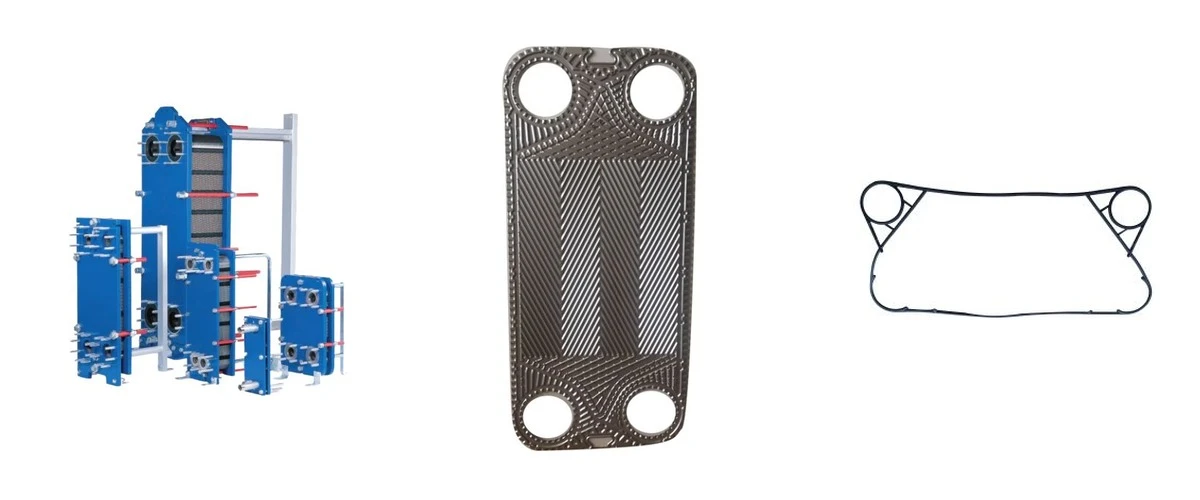
Complete Plate Heat Exchangers
Complete units selected according to thermal duty, flow rate, temperature program, pressure conditions and installation requirements.
View Plate Heat Exchangers →Heat Exchanger Plates
Replacement plates matched according to exchanger model, plate geometry, material, flow arrangement and operating conditions.
View Heat Exchanger Plates →Heat Exchanger Gaskets
Replacement gaskets selected according to exchanger model, sealing profile, fluid, temperature and pressure.
View Heat Exchanger Gaskets →Replacing Plates or Gaskets in an Existing HVAC PHE
For maintenance projects, the existing equipment information should be verified before replacement components are confirmed.
Provide the manufacturer and full exchanger model where available.
Send a clear photo of the existing equipment nameplate.
Photograph both plate faces and the gasket profile where possible.
Provide dimensions, material information and required quantity.
From HVAC Duty Data to Product Selection
A useful quotation starts with the operating data. For a new HVAC or district-heating project, provide both fluids, flow rates, temperatures, pressure and allowable pressure drop. For an existing exchanger, add the equipment model, nameplate and component photos.
Information to Prepare Before Requesting a Quote
Heating, chilled water, DHW or pressure separation.
Hot water, steam or another medium.
Water, glycol or another medium.
Flow on both sides with clear units.
Inlet and required outlet temperatures.
Working and design pressure.
Maximum allowable pressure drop.
Brand/model for replacement projects.
Required units, plates or gaskets.
Destination country for quotation.
Common Plate Heat Exchanger Questions
Provide both fluids, flow rates, inlet and required outlet temperatures, operating pressure, allowable pressure drop and installation requirements.
Yes. A plate heat exchanger can hydraulically separate building circuits so that downstream equipment does not experience the full static pressure of the entire building height.
Yes, when the exchanger and control arrangement are selected for the steam conditions. Steam pressure, condensate removal, load variation and water-hammer risk should be considered.
Material selection depends on water chemistry, chlorides, temperature, treatment chemicals and cleaning conditions rather than the HVAC application name alone.
Possible causes include excessive flow, scaling, suspended solids, blocked channels or a configuration that does not match the actual hydraulic conditions.
Replacement matching can be reviewed using the exchanger brand and model, nameplate, component photos, dimensions, material and required quantity.
There is no universal fixed interval. Cleaning should be based on water quality, fouling tendency, pressure-drop changes and heat-transfer performance.
Send Your HVAC or District Heating Data for Technical Review
Please provide both fluids, flow rates, inlet and outlet temperatures, working pressure and allowable pressure drop. For replacement projects, include the existing brand, model, nameplate and clear plate or gasket photos.
Request HVAC Technical Support →HVAC & District Heating Plate Heat Exchanger Inquiry
Send your project or replacement data for review of a complete plate heat exchanger, replacement plate or compatible gasket.