


Marine Plate Heat Exchangers for Seawater, Fresh Water & Oil Cooling
Marine cooling systems operate under demanding conditions including seawater corrosion, vibration, limited engine-room space and changing thermal loads.
We supply three core product groups for marine heat-transfer projects: complete plate heat exchangers, replacement heat exchanger plates and compatible gaskets.
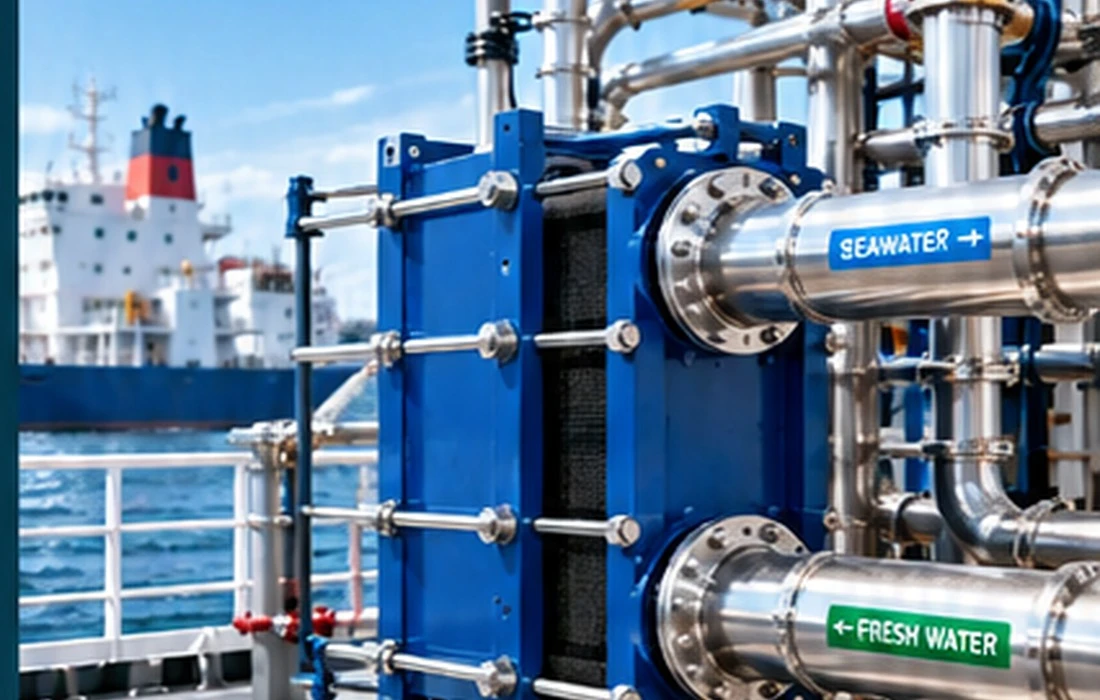
Why Marine Plate Heat Exchangers Require Application-Specific Selection
Marine duty differs from ordinary industrial water service. Selection should reflect the actual fluids, seawater chemistry, installation environment and maintenance conditions.
High chloride concentration requires careful plate-material selection.
Ship motion and machinery vibration affect installation and long-term reliability.
Compact footprint and maintenance clearance should be considered together.
Plate and gasket materials must match lubricating oil, seawater or fresh water.
Deposits and biological fouling can increase pressure drop and reduce heat transfer.
Where Plate Heat Exchangers Are Used Onboard
Plate heat exchangers can serve several cooling duties within propulsion, generator and auxiliary systems.
Central Cooling System
Central cooling can reject heat from ship-side fresh-water circuits to seawater and support cooling for main engines, generators and auxiliary machinery.
- High-temperature fresh water
- Low-temperature fresh water
- Generator cooling
- Auxiliary machinery cooling
Lubricating Oil Cooling
Plate heat exchangers can control lubricating-oil temperature for main engines, generators and auxiliary machinery.
- Lubricating oil / seawater
- Lubricating oil / fresh water
- Oil-compatible gasket selection
- Pressure-drop control
Fresh-Water & Seawater Cooling
Fresh-water coolers maintain equipment temperature while seawater can serve as the cold-side heat sink without mixing with the ship-side circuit.
- Fresh water / fresh water
- Fresh water / seawater
- Chloride concentration review
- Heat recovery where applicable
Select Plate Material According to the Actual Marine Medium
Material selection should be based on chloride concentration, temperature and corrosion conditions rather than the word "marine" alone.
| Operating Medium | Plate Material Direction | Main Selection Reason |
|---|---|---|
| Fresh Water / Fresh Water | 304 / 316L may be considered | Suitable direction for many general fresh-water duties, subject to actual water chemistry. |
| Seawater | Titanium | Commonly considered for resistance to chloride corrosion. |
| High-Chloride Medium | Titanium | Helps reduce chloride-corrosion risk. |
| More Aggressive Corrosive Conditions | Evaluate higher corrosion-resistant alloys | Final choice depends on actual fluid chemistry and temperature. |
Select Gaskets by Model, Medium, Temperature & Pressure
The correct gasket compound depends on the exchanger model, sealing profile and actual operating conditions.
Confirm the gasket profile and component fit before replacement.
Oil, seawater and fresh water can require different gasket compounds.
Confirm continuous operating temperature and temperature cycling.
Working pressure and sealing requirements should be checked together.
Key Data Required for Marine Heat Exchanger Selection
Heat-transfer area alone is not enough for reliable selection. Actual process data is needed to review the exchanger configuration.
Lubricating oil, fresh water or other process medium.
Seawater, fresh water or other cooling medium.
Provide flow rate for both sides with clear units.
Provide inlet and required outlet temperatures.
Provide working or design pressure on each side.
State the maximum acceptable pressure drop where known.
Include engine-room footprint and maintenance-clearance restrictions.
Confirm connection size, direction and piping arrangement.
Design for Stable Operation and Service Access
Installation Considerations
- Use a reasonable piping layout to avoid unnecessary resistance.
- Remove trapped air from the exchanger circuit during commissioning.
- Confirm hot-side and cold-side connection arrangement.
- Leave sufficient clearance for opening the frame and removing plates.
- Evaluate upstream filtration when cooling water may contain particles or debris.
Maintenance Considerations
- Monitor pressure drop and outlet temperature over time.
- Clean according to seawater condition and fouling tendency.
- Inspect plates for deposits, corrosion, cracks or deformation.
- Inspect gaskets for aging, leakage or sealing loss.
- Replace damaged plates or gaskets when required.
We Export Three Core Plate Heat Exchanger Product Groups
Marine applications are supported through complete plate heat exchangers, heat-transfer plates and replacement gaskets.
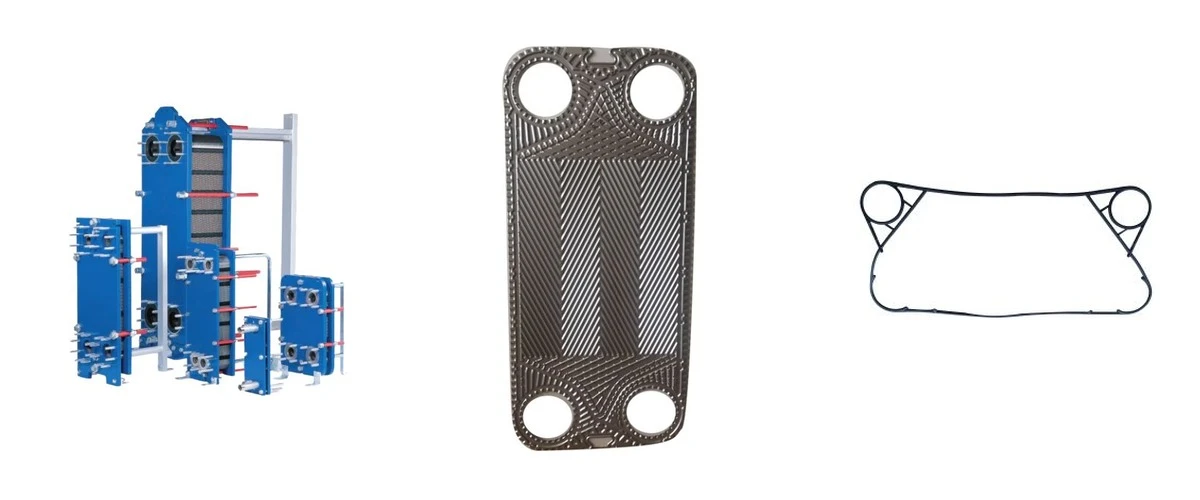
Complete Plate Heat Exchangers
Complete units for thermal duties such as central cooling, fresh-water cooling, lubricating-oil cooling and seawater heat exchange.
View Plate Heat Exchangers →Heat Exchanger Plates
Replacement or new-project plates selected according to exchanger model, plate geometry, material and operating conditions.
View Heat Exchanger Plates →Heat Exchanger Gaskets
Replacement gaskets matched according to exchanger model, sealing profile, medium, temperature and pressure.
View Heat Exchanger Gaskets →Replacing Plates or Gaskets in an Existing Marine PHE
For existing units, identification information is often more useful than a general request for "marine plates" or "marine gaskets."
Provide the existing exchanger manufacturer and model.
Send a clear nameplate photo showing available equipment information.
Provide clear plate and gasket photos when available.
Include plate or gasket dimensions, existing material and required quantity.
Support for New Marine Projects and Replacement Requirements
Marine procurement may involve a new complete exchanger or replacement components for an existing unit. Technical review should therefore connect operating data with product configuration and replacement compatibility.
Prepare These Details Before Requesting a Quote
Vessel or project type.
Central, oil, fresh-water or seawater cooling.
Hot-side and cold-side media.
Flow rates and inlet/outlet temperatures.
Working pressure and allowable pressure drop.
Brand and model for replacement projects.
Nameplate, plate and gasket photos.
Existing or required material if known.
Required unit or component quantity.
Destination country for quotation.
Common Marine Plate Heat Exchanger Questions
Seawater contains high chloride levels. Titanium is commonly considered because of its corrosion resistance in many seawater duties.
Suitability depends on chloride concentration, temperature and complete water chemistry. Direct seawater service should be reviewed before selecting stainless steel.
Provide both fluids, flow rates, inlet and required outlet temperatures, operating pressure, allowable pressure drop and installation requirements.
Selection should consider exchanger model, gasket profile, oil type, operating temperature, pressure and chemical compatibility.
Send the existing brand, model, nameplate, component photos, dimensions and any available reference numbers.
Possible causes include fouling, channel blockage, excessive flow rate or an unsuitable plate/process configuration.
Cleaning frequency should be based on seawater quality, fouling tendency, pressure-drop changes and heat-transfer performance rather than a fixed universal interval.
Send Your Marine Cooling Data for Technical Review
Please provide fluids, flow rates, inlet/outlet temperatures, working pressure, allowable pressure drop, ship application and installation requirements. For replacement projects, also include the existing brand, model, nameplate and clear component photos.
Request Marine Technical Support →Marine Plate Heat Exchanger Inquiry
Send your project or replacement data for review of a complete plate heat exchanger, replacement plate or compatible gasket.