


Plate Heat Exchangers for Power Plant Cooling & Energy Recovery
Power and energy systems require reliable heat removal, stable equipment temperatures, controlled pressure drop and efficient use of recoverable thermal energy.
WTSML supplies complete plate heat exchangers, replacement heat-transfer plates and compatible gaskets for transformer-oil cooling, generator-bearing oil cooling, closed cooling-water circuits and waste-heat recovery duties.
Where Are Plate Heat Exchangers Used in Power & Energy Systems?
Plate heat exchangers are commonly used in auxiliary cooling, oil cooling, closed-water circuits and heat-recovery systems where two fluid circuits must exchange heat without directly mixing.
Remove heat from transformer-oil circuits through a separate cooling-water loop while keeping oil and water physically separated.
Control bearing lubricating-oil temperature to support stable operation of generator and auxiliary rotating equipment.
Separate clean internal cooling-water circuits from external cooling-water systems and different water-quality conditions.
Transfer usable heat from warm water or suitable process streams into heating-water or another secondary circuit.
Common Plate Heat Exchanger Applications in Power Systems
Transformer Oil Cooling
High-voltage transformer equipment generates heat during operation. A separate cooling circuit can remove heat from transformer oil without mixing the oil and cooling water.
- Transformer-oil cooling
- Oil / water heat transfer
- Oil-compatible gasket review
- Cooling-water quality review
Generator Bearing Oil Cooling
Generator bearing and lubricating-oil systems require controlled oil temperature to remove heat generated during continuous operation.
- Bearing-oil cooling
- Lubrication-system cooling
- Auxiliary equipment cooling
- Oil / water separation
Closed Cooling-Water Systems
Plate heat exchangers can isolate a clean internal water loop from an external cooling-water circuit.
- Closed-loop cooling water
- Auxiliary equipment cooling
- Water-quality separation
- Cooling-circuit isolation
Separate Equipment Cooling from the External Cooling Circuit
A plate heat exchanger allows the equipment-side circuit to remain independent while transferring heat to a secondary cooling-water system.
Heat Source
Transformer oil, generator bearing oil or closed cooling water absorbs equipment heat.
Plate Heat Exchanger
Heat transfers across corrugated plates while the two fluid circuits remain separated.
Secondary Cooling Water
Cooling water removes heat from the equipment-side circuit.
Stable Return Temperature
The cooled fluid returns to equipment according to the required operating temperature.
Recover Useful Low-Grade Heat Instead of Rejecting It
Power and industrial-energy systems often discharge useful thermal energy through warm cooling water or condensate-related streams. Where temperatures are suitable, that heat can be transferred to another water circuit.
Use suitable waste heat to raise the temperature of a secondary heating-water circuit.
Recover available heat from suitable power-plant water streams for secondary hot-water duties.
Transfer recovered heat into a separate heating-water circuit where system temperatures and economics are suitable.
Evaluate recoverable thermal energy before it is finally rejected to the environment.
Five Factors That Affect Power-System PHE Performance
Auxiliary cooling systems may operate for long periods and need stable thermal performance.
Excessive hydraulic resistance increases circulating-pump power consumption.
Salts, particles and biological activity can contribute to scaling, fouling or corrosion.
Plate and gasket selection should account for transformer or lubricating-oil operating conditions.
Fouling and gasket aging should be detected before cooling performance becomes insufficient.
More Flow Is Not Always Better
Higher flow velocity can strengthen heat transfer, but it also increases hydraulic resistance and circulating-pump energy use.
Increased turbulence can improve the heat-transfer coefficient.
Increased flow velocity also raises pressure drop through the plate channels.
Higher pressure drop can increase the electrical power required by circulation pumps.
Plate geometry and channel arrangement should balance heat transfer with acceptable energy consumption.
Information Required for Power & Energy Heat Exchanger Selection
Transformer oil, lubricating oil, warm water or another process medium.
Cooling water, closed-loop water or another secondary medium.
Provide design flow rates on both sides with clear units.
Provide inlet and required outlet temperatures on both sides.
Provide required heat load where available.
Provide actual operating and design pressure.
State acceptable pressure loss on each circuit.
Provide oil grade, water quality or other relevant fluid information.
Match Materials to Cooling Water, Oil & Operating Conditions
| Selection Item | Information to Confirm | Why It Matters |
|---|---|---|
| Plate Material | Cooling-water chemistry, chlorides, temperature and corrosion conditions | Determines corrosion risk and suitable plate-material direction. |
| Gasket Compound | Oil or water medium, operating temperature and pressure | Gasket compatibility directly affects sealing reliability. |
| Plate Geometry | Flow rate, heat duty and allowable pressure drop | Channel geometry influences both heat transfer and pump-energy demand. |
| Plate Quantity | Thermal duty and required temperature approach | Plate-pack configuration should be calculated from the real cooling duty. |
Protect Heat-Transfer Performance from Deposits & Blockage
Dissolved salts can form deposits as water chemistry and temperature change.
Welding slag, suspended solids and other debris can enter channels and increase pressure drop.
Cooling-water systems can develop biological deposits when operating conditions allow growth.
Rising pressure drop or worsening outlet temperature can indicate increasing fouling.
Design for Reliable Continuous Operation
Installation Considerations
- Confirm equipment-side and cooling-side connections.
- Maintain the required design flow through both circuits.
- Remove trapped air during commissioning.
- Provide sufficient plate-pack maintenance clearance.
- Evaluate filtration where cooling water contains debris.
- Confirm pump operation against the selected pressure drop.
Maintenance Considerations
- Monitor inlet and outlet temperatures.
- Track pressure-drop changes over time.
- Inspect plates for scale, deposits and corrosion.
- Inspect gaskets for hardening, swelling or leakage.
- Clean according to actual water quality and fouling mechanism.
- Investigate root cause before replacing repeatedly failed components.
Three Core Plate Heat Exchanger Product Groups
Power and energy applications are supported through complete plate heat exchangers, replacement heat-transfer plates and replacement gaskets.
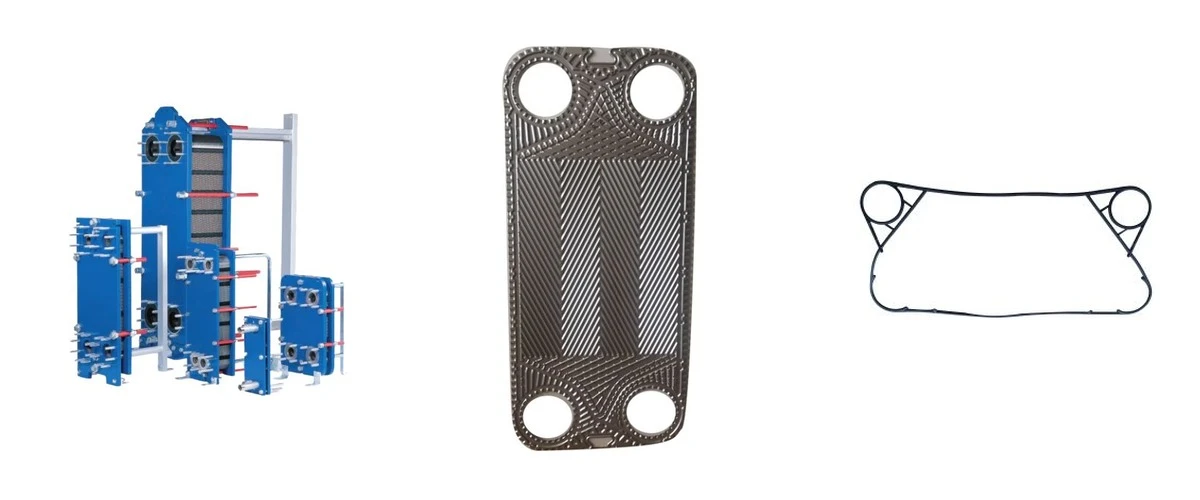
Complete Plate Heat Exchangers
Complete units selected according to cooling duty, fluid type, flow rate, temperatures, pressure and allowable pressure drop.
View Plate Heat Exchangers →Heat Exchanger Plates
Replacement or new-project plates matched according to exchanger model, plate geometry, material and operating conditions.
View Heat Exchanger Plates →Heat Exchanger Gaskets
Replacement gaskets selected according to exchanger model, sealing profile, oil or water medium, temperature and pressure.
View Heat Exchanger Gaskets →Replacing Plates or Gaskets in an Existing Power-System PHE
Existing exchanger identification and real cooling conditions should be reviewed together before replacement components are confirmed.
Provide the existing exchanger manufacturer and complete model.
Send a clear photograph of the exchanger nameplate.
Component photos support plate geometry and gasket-profile identification.
Include media, flow, temperatures, pressure and required quantity.
From Power-System Cooling Data to Product Selection
For new projects, provide hot-side and cold-side media, flow rates, temperatures, thermal duty, working pressure and allowable pressure drop. For replacement projects, also provide the existing exchanger model, nameplate and clear component photos.
Prepare These Details Before Requesting a Quote
Transformer oil, bearing oil, cooling water or heat recovery.
Oil, warm water or another process fluid.
Cooling water or another secondary medium.
Both-side flow rates with clear units.
Inlet and required outlet temperatures.
Required kW or other heat-load data where available.
Working and design pressure.
Maximum allowable pressure loss.
Brand and model for replacement projects.
Required quantity and destination country.
Common Power-System Plate Heat Exchanger Questions
Provide both media, flow rates, inlet and required outlet temperatures, thermal duty, working pressure and allowable pressure drop.
Yes, transformer oil cooling is one of the documented power-industry applications of plate heat exchangers. The final selection should consider oil properties, cooling-water conditions, temperatures, flow and pressure.
Yes. Generator bearing oil cooling is a typical power-industry duty. Gasket compatibility with the oil and actual temperature and pressure should be reviewed.
Pressure drop affects circulating-pump power. Increasing velocity can strengthen heat transfer, but excessive hydraulic resistance increases energy consumption.
Suitable warm water or condensate-related streams may provide recoverable heat. Feasibility depends on source temperature, flow, operating hours and the temperature required by the receiving circuit.
Fouling, scaling, particles, channel blockage, increased viscosity or excessive flow can all increase hydraulic resistance.
Replacement matching can be reviewed using the existing exchanger brand and model, nameplate, plate and gasket photos, dimensions, material and required quantity.
Send Your Power-System Cooling Data for Technical Review
Please provide both media, flow rates, inlet and outlet temperatures, thermal duty, working pressure and allowable pressure drop. For replacement projects, include the existing brand, model, nameplate and clear component photos.
Request Power & Energy Technical Support →Power & Energy Plate Heat Exchanger Inquiry
Send your new-project or replacement information for review of a complete plate heat exchanger, replacement plate or compatible gasket.