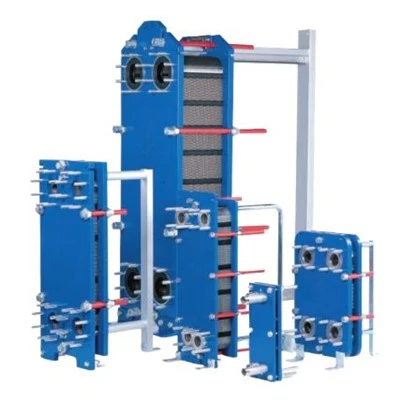
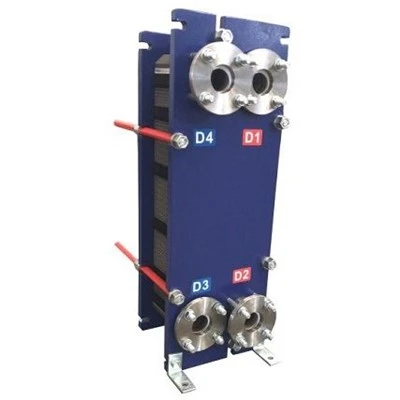
SIGMA Series
SIGMA 7 · SIGMA 9 · SIGMA 13
SIGMA 19 · SIGMA 25 · SIGMA 26
SIGMA 27 · SIGMA 35 · SIGMA 36
SIGMA 37 · SIGMA 55 · SIGMA 56
SIGMA 66 · SIGMA 76 · SIGMA 96
 English


API Schmidt-Bretten SIGMA Series | Independent Aftermarket Plates
We support replacement plate enquiries for identified API Schmidt-Bretten gasketed plate heat exchangers, including selected SIGMA, SIGMA M, SIGMA X and SIGMA STAR model references. These are independently sourced aftermarket components, not original Schmidt or API parts.
Correct replacement requires verification of the complete model, pressed plate pattern, port layout, gasket groove, material, thickness and position in the existing plate pack. Stainless steel, titanium and selected special-alloy options can be reviewed against the operating conditions.
Request Schmidt Plate Matching & Quote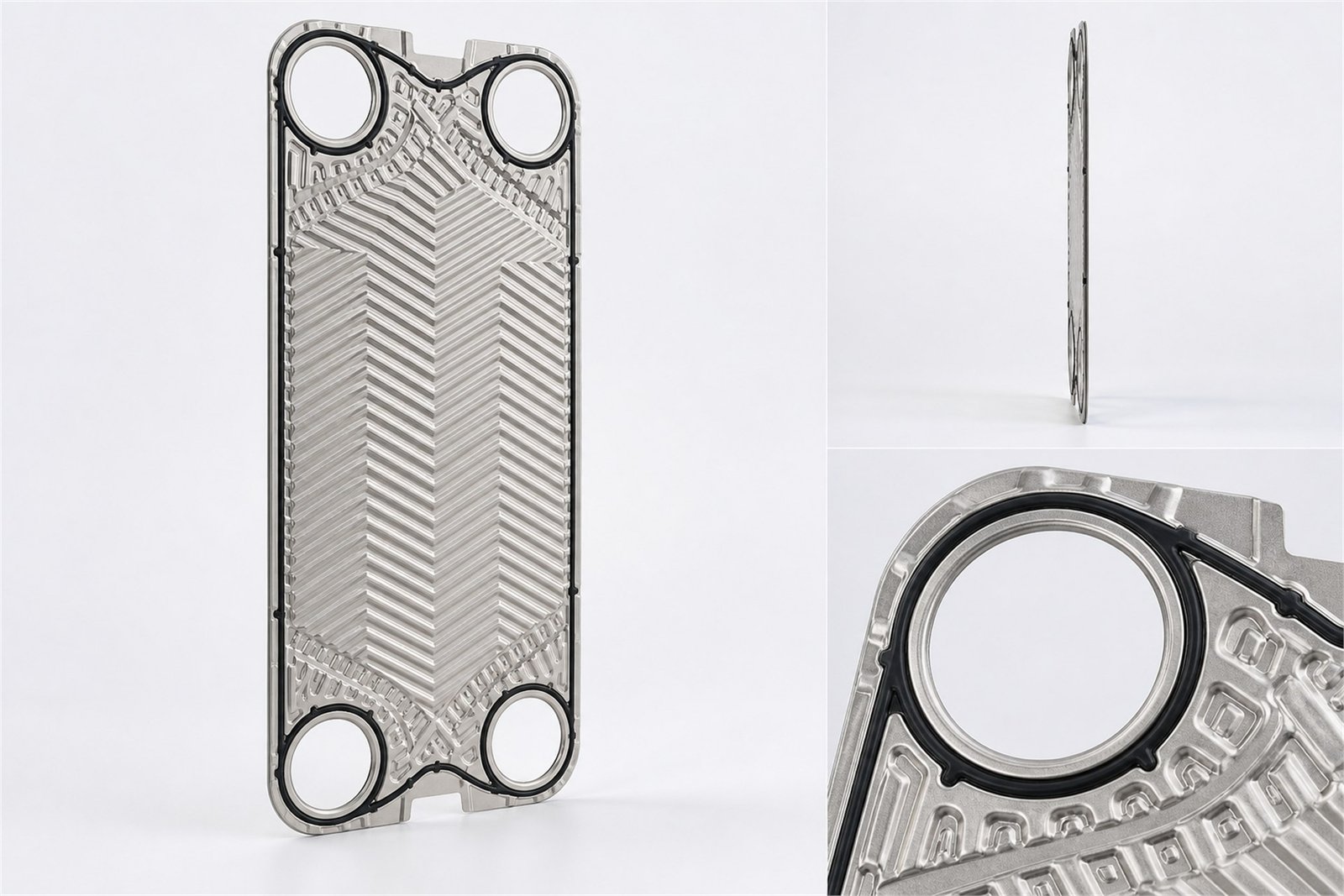
General replacement plate illustration. Exact Schmidt plate profiles are confirmed by model and original sample.
Published aftermarket catalogs include several API Schmidt-Bretten SIGMA plate heat exchanger model families. The following names are useful cross-references when identifying legacy equipment and preparing replacement plate enquiries.
SIGMA 7 · SIGMA 9 · SIGMA 13
SIGMA 19 · SIGMA 25 · SIGMA 26
SIGMA 27 · SIGMA 35 · SIGMA 36
SIGMA 37 · SIGMA 55 · SIGMA 56
SIGMA 66 · SIGMA 76 · SIGMA 96
SIGMA M13 · SIGMA M25
SIGMA M26 · SIGMA M35
SIGMA M36 · SIGMA M37
SIGMA M55 · SIGMA M56
SIGMA M66 · SIGMA M76
SIGMA M96 · SIGMA M106
SIGMA M136 · SIGMA M156
SIGMA X13 · SIGMA X19
SIGMA X29 · SIGMA X49
SIGMA STAR 45
SIGMA STAR 90
Other public replacement-part lists include SIGMA 22, SIGMA 32, SIGMA 38, SIGMA 48, SIGMA 85, SIGMA 106, SIGMA 136 and SIGMA 156. The original writing of each model should be retained until its exact equipment designation has been confirmed.
Model-list status: These designations are third-party catalog cross-references, not a confirmed PHE SERVICE stock list. A SIGMA 25 and SIGMA M25, or SIGMA 35 and SIGMA M35, must not be treated as interchangeable simply because they share a number. Full suffixes, plate markings and physical dimensions are required.
Replacement plates must reproduce the required geometry and sealing interfaces of the existing plate pack. A matching name or similar plate outline is not sufficient evidence of interchangeability.
Record the complete SIGMA model, suffix and all readable plate markings.
Check overall length, width, support points and port-center distances.
Match corrugation pattern, channel depth, orientation and contact points.
Confirm open or closed ports, diameters and intended flow passages.
Verify sealing groove, port-ring geometry and gasket retaining features.
Confirm alloy, thickness, plate orientation and position in the pack.
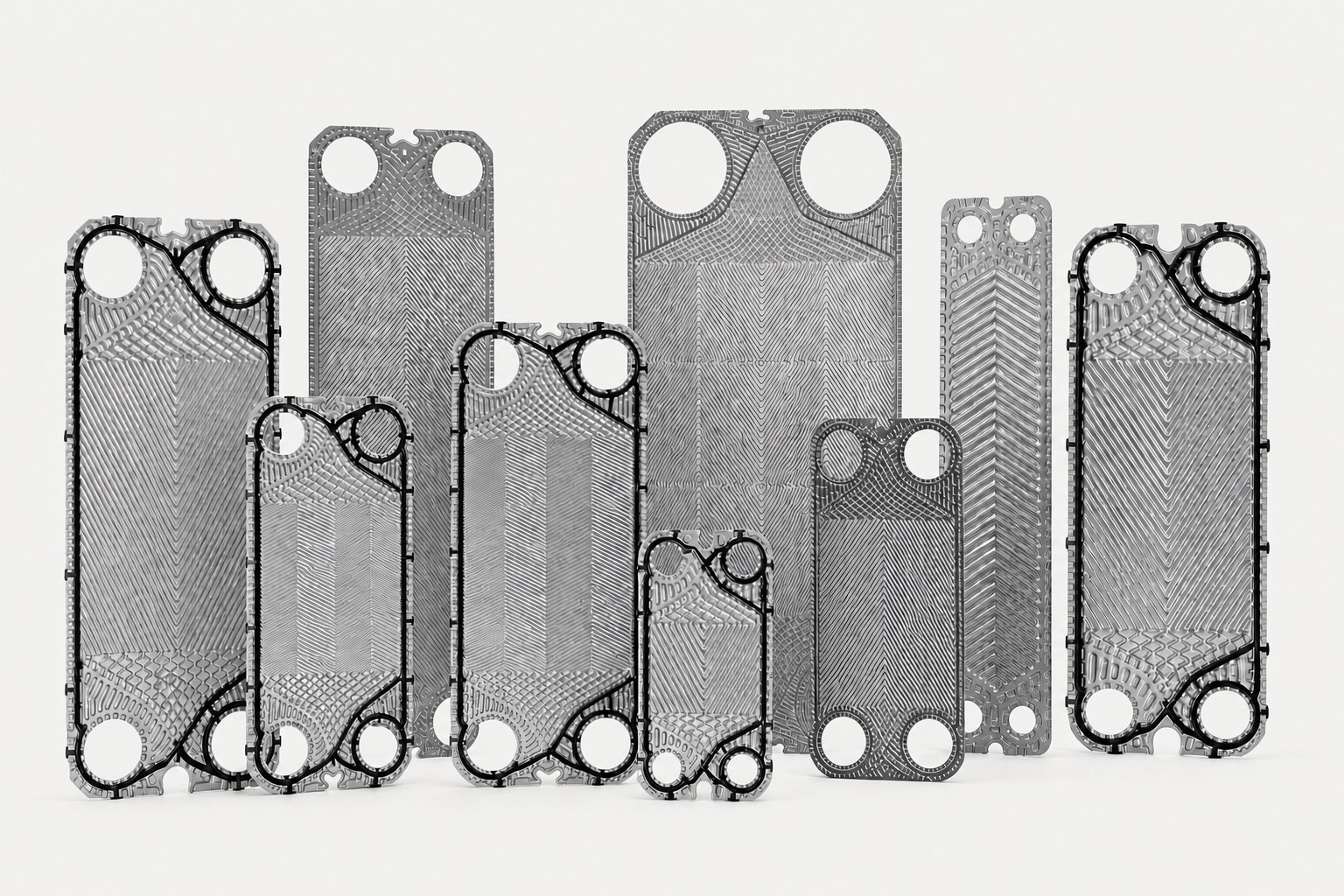
General plate and gasket examples. Schmidt model-specific geometry must be confirmed separately.
Measurement reminder: Overall plate dimensions differ from horizontal and vertical port-center distances. Include units and measurement points with every submitted dimension.
API Schmidt-Bretten has used multiple heat exchanger construction families. An ordinary removable gasketed SIGMA plate should not be confused with a permanently joined plate core.
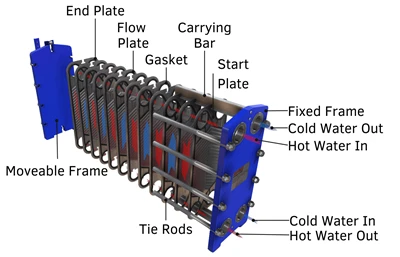
A removable plate-and-frame construction uses a compressed plate pack and replaceable sealing gaskets.
Replacement work focuses on the correct plate profile, gasket groove, port layout and installed sequence.
Semi-welded construction combines welded channel connections with appropriate gasketed sealing interfaces.
Its components and replacement procedure must not be treated as conventional SIGMA gasketed plates.
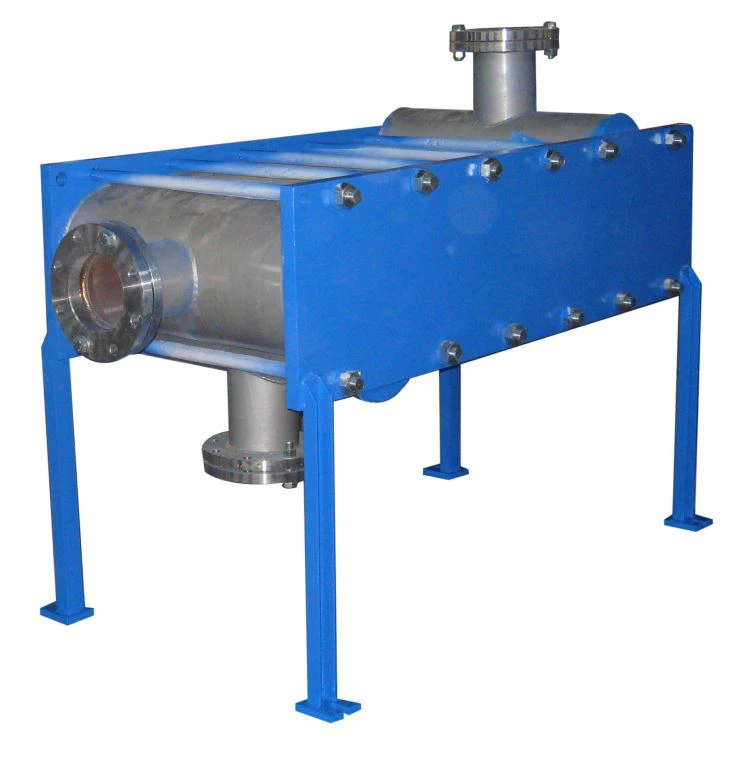
SIGMASHELL and SIGMAWIG identify other welded exchanger construction families.
Their replacement-part requirements are not interchangeable with a standard removable SIGMA plate pack.
Product scope: This page primarily concerns independently sourced replacement metal plates for identified gasketed Schmidt SIGMA configurations. Any semi-welded or fully welded equipment enquiry requires separate technical review.
The plate alloy must be selected for the complete operating environment: both process fluids, concentration, temperature, pressure, contaminants and cleaning chemicals. Materials mentioned in industry catalogs are options for review, not guaranteed availability for every SIGMA model.
| Plate Material | Selection Context | Buyer Verification |
|---|---|---|
| AISI 304 / 304L | Industrial utility and water-based service where the selected stainless steel is chemically suitable. | Chlorides, water chemistry, temperature and cleaning medium. |
| AISI 316 / 316L | Process and utility service where a molybdenum-bearing stainless steel meets corrosion requirements. | Fluid composition, chloride level, corrosion history, pH and temperature. |
| Titanium | Often evaluated for selected seawater and chloride-bearing cooling applications. | Exact titanium grade, full fluid chemistry, temperature and cleaning. |
| Titanium-Palladium | Specialist titanium alloy for particular demanding corrosion conditions. | Alloy specification, process chemistry and model-specific feasibility. |
| 254 SMO / SMO254 | High-alloy stainless steel considered for certain corrosion-sensitive industrial duties. | Exact grade, chlorides, temperature and manufacturing capability. |
| Hastelloy C-276 | Nickel-based alloy considered for selected aggressive process fluids. | Chemical concentration, temperature, exact grade and plate-forming feasibility. |
Material substitution: A material change from stainless steel to titanium or another alloy requires review of corrosion behavior, mechanical compatibility, gasket material and the full plate-pack requirements. Alloy selection is not based on chloride content alone.
Third-party Schmidt SIGMA catalogs contain dimensional references, but legacy model tables can contain inconsistent measurement order and transcription errors. Final replacement dimensions should be checked against the original equipment, drawing or reference plate.
| Parameter | What to Record | Why It Matters |
|---|---|---|
| Exact Model | SIGMA model, prefix, suffix and stamped identification. | Distinguishes similar numbering families. |
| Overall Plate Size | Length and width in mm, including measurement points. | Supports plate outline and frame matching. |
| Port Diameter | Actual port opening diameter for the required plate type. | Verifies fluid connection and port sealing geometry. |
| Port Center Distance | Horizontal and vertical center-to-center distances. | Helps distinguish similar plate sizes. |
| Pressing Depth | Channel depth and original corrugation profile. | Affects channel geometry, flow and plate contact. |
| Heat Transfer Area | Effective area specified for the actual plate. | Supports thermal performance verification. |
| Material / Thickness | Exact alloy grade and sheet thickness. | Important for mechanical and corrosion requirements. |
| Plate Configuration | Corrugation orientation, port closures and position in the pack. | Preserves correct fluid routing and sealing. |
| Gasket Specification | Groove design, gasket attachment and compound. | Ensures the replacement fits the sealing system. |
Important: We do not treat a dimension copied from an unrelated aftermarket catalog as the final specification of a customer's plate. Original drawings, samples and engineering confirmation take priority before quotation.
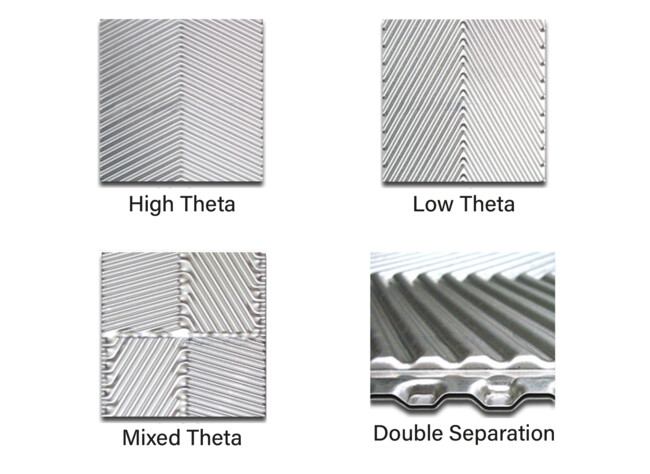
General chevron and corrugated-channel reference.
Corrugated metal plates create alternating fluid channels inside a gasketed plate heat exchanger. The pressed pattern influences heat transfer, hydraulic resistance and mechanical contact between adjacent plates.
Some pressed plate geometries produce stronger turbulence and heat-transfer intensity, commonly accompanied by increased pressure drop.
The suitability of these patterns depends on the process duty and available pumping pressure.
Other plate geometries favor lower flow resistance, which may be important where pressure drop is limited by the system.
Reduced resistance does not automatically mean the replacement provides adequate heat-transfer capacity.
Engineering requirement: Chevron classifications such as high theta and low theta are general design terminology. The actual pressing geometry, angle convention and plate-pack arrangement must be verified for the existing Schmidt model.
Industrial heat-transfer plates are formed from sheet metal into specified channel and sealing geometries. Precise dimensional control is important when a replacement must fit an existing plate pack.
Any required inspection records, material certificates or testing evidence should be agreed as part of the specific order requirements.
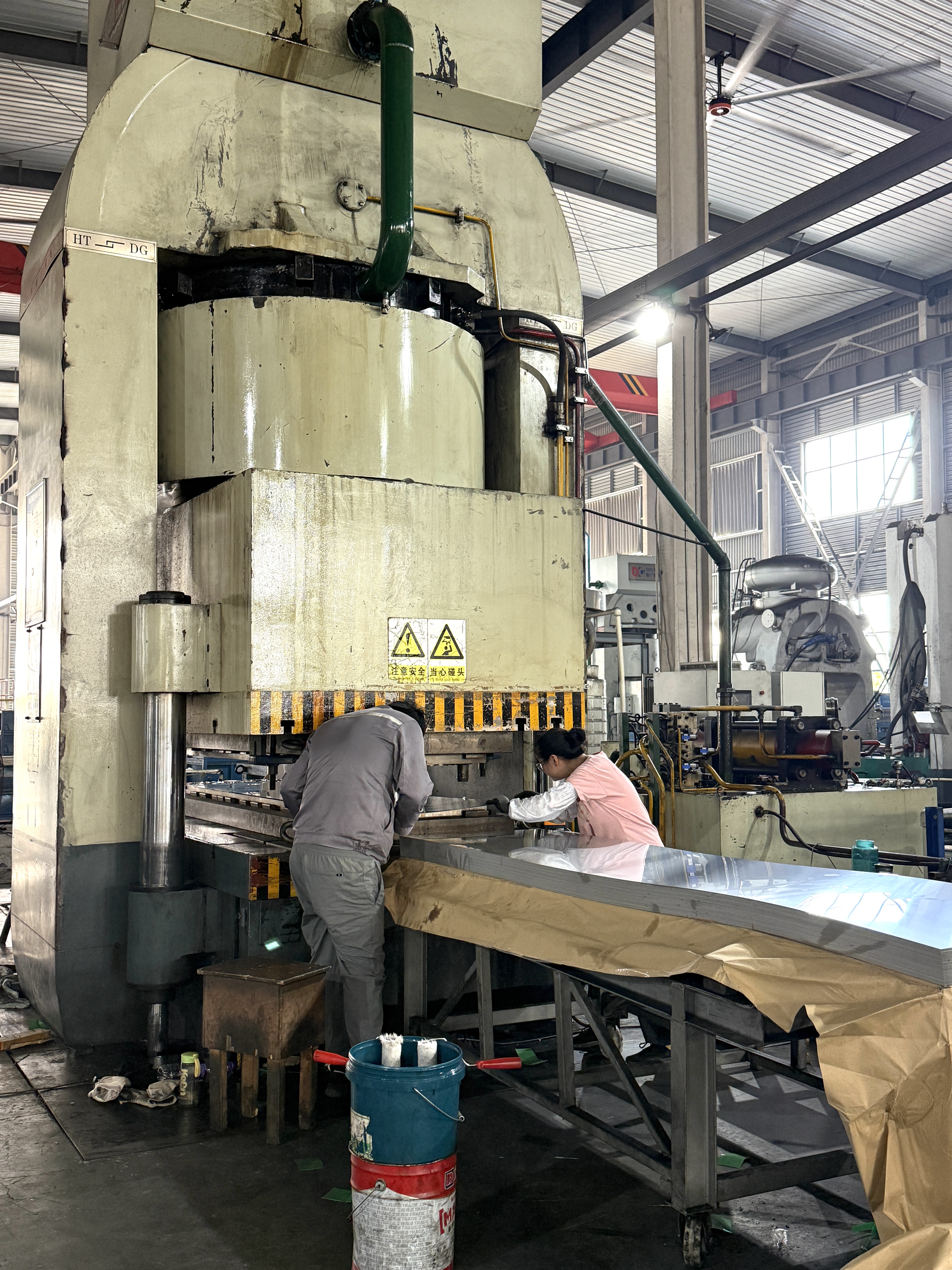
Third-party industrial press-forming reference image. Not a photograph of PHE SERVICE facilities.
Leaks and reduced heat-transfer performance require diagnosis. Cleaning, gasket replacement or plate renewal may be appropriate depending on the actual cause.
Localized corrosion may compromise separation between process streams. Review the failure mechanism before changing plate material.
Damage to pressed channels, port areas or plate edges may prevent reliable mechanical fit and sealing.
Distortion or damage in the sealing groove may cause repeated leakage despite a new gasket.
Replacing selected plates may be considered where the affected positions are identified and the remaining pack is serviceable.
Widespread deterioration or major refurbishment may require assessment of a complete replacement plate pack.
Assembly precaution: Do not arbitrarily change plate orientation, plate count, flow arrangement or frame closing dimension. Follow the approved assembly drawing and equipment procedure.
Schmidt gasketed plate exchangers may be used for process cooling, heating and heat recovery. Replacement plate selection must reflect the specific equipment and fluid conditions.
Processing and utility heat-transfer duties with applicable hygiene requirements.
Hot water, chilled water and compatible glycol circuits.
Temperature control requiring chemical compatibility review.
Freshwater cooling and selected seawater applications.
Auxiliary cooling and industrial thermal utility systems.
Equipment lubrication and compatible hydraulic-oil circuits.
Thermal process and utility duties with suitable equipment design.
Process water heating, machinery cooling and heat recovery.
Record the full SIGMA model, nameplate and original plate markings.
Photograph both faces and record dimensions, ports and gasket groove.
Confirm material, thickness, fluid duty and required positions.
Confirm quantities, matching gaskets, documents and destination.
Are these genuine API Schmidt-Bretten heat exchanger plates?
No. These are independently sourced aftermarket replacement components for verified compatible configurations. Schmidt and API Schmidt-Bretten names identify the original equipment only and do not imply OEM authorization or affiliation.
Are SIGMA 25 and SIGMA M25 replacement plates interchangeable?
Interchangeability cannot be assumed. The complete model designation, physical dimensions, pressed pattern, ports, gasket groove and installed plate arrangement require individual verification.
Can Schmidt SIGMA plates be replaced individually?
Individual replacement may be possible when the affected position is identified and the remaining plate pack is suitable for continued service. Geometry, material, ports, orientation and gasket interfaces must be matched.
Can SIGMA gasketed plates replace SIGMADUAL semi-welded plates?
No general interchangeability should be assumed. Gasketed and semi-welded plate assemblies use different construction and sealing arrangements. The actual equipment type must be identified before replacement parts are specified.
Can titanium Schmidt plates replace stainless steel plates?
A material change requires technical review of both fluids, corrosion conditions, temperatures, mechanical requirements and gasket compatibility. Titanium is not universally suitable for all process media.
Are third-party SIGMA dimensional tables sufficient for ordering?
No. Published dimensions can help identify possible models, but they should be checked against the original plate or approved drawing. Some aftermarket tables contain different dimension conventions or inconsistent values.
Can replacement Schmidt plates and gaskets be ordered together?
Matching plate and gasket requirements can be reviewed together. Please provide the equipment model, gasket fixing method, operating fluids, temperature and quantity. Availability is confirmed during quotation.
What should I send if the Schmidt plate model is unreadable?
Send the exchanger nameplate, clear photographs of both plate faces, port openings, gasket groove, hanging features, overall dimensions and port-center distances. A drawing or original sample may be needed for legacy models.
Please send your full API Schmidt-Bretten SIGMA model, nameplate, plate markings, photographs, material, thickness, dimensions, port configuration, operating conditions, required quantities and destination country.
Include matching gasket requirements, drawings or an original sample reference where available.
As one of the most professional schmidt plate manufacturers and suppliers in China, we have world-leading production equipment and strong manufacturing capabilities. We warmly welcome you to wholesale advanced schmidt plate made in China here from our factory. Customized orders are welcome.
plate heat transfer component