


Plate Heat Exchangers for Pharmaceutical Process Heating & Cooling
Pharmaceutical and medical-material processes can require precise temperature control, reliable separation between process and utility circuits, suitable material compatibility and repeatable cleaning conditions.
WTSML supplies complete plate heat exchangers, replacement heat-transfer plates and compatible gaskets for pharmaceutical process heating, cooling, utility heat exchange and heat-recovery duties.
Where Are Plate Heat Exchangers Used in Pharmaceutical Processing?
Plate heat exchangers can provide indirect heating or cooling between pharmaceutical process fluids and separate utility circuits while maintaining physical separation between the media.
Raise process-medium temperature through a separate heating-water or other suitable utility circuit.
Remove heat from pharmaceutical or medical-material process streams using a separate cooling circuit.
Transfer heat between independent utility loops where hydraulic or process separation is required.
Recover useful thermal energy from suitable warm process or utility streams for reuse elsewhere in the process.
Typical Heat-Transfer Requirements
Temperature Control
Many pharmaceutical and medical-material processes require the product or intermediate fluid to remain within a defined temperature range.
- Process-liquid heating
- Process-liquid cooling
- Batch temperature adjustment
- Intermediate-loop temperature control
Utility Separation
A plate heat exchanger allows thermal energy to pass between separate circuits without directly mixing the process medium and the utility medium.
- Heating-water circuits
- Cooling-water circuits
- Secondary process loops
- Independent utility circuits
Process Heat Recovery
Heat from a suitable warm stream can be transferred to another compatible circuit where the temperature level makes recovery technically useful.
- Preheating
- Process-water heating
- Utility heat recovery
- Cooling-load reduction
Select from the Process Medium, Not the Industry Name Alone
Pharmaceutical-duty selection starts with actual process and utility conditions before plate geometry, plate material or gasket material are confirmed.
Define the Media
Identify the process and utility fluids, concentration and relevant chemical characteristics.
Define the Duty
Confirm flow rates, inlet temperatures and required outlet temperatures.
Review Materials
Select plate and gasket materials according to medium, temperature, pressure and cleaning conditions.
Confirm Configuration
Review plate geometry, pressure drop, connection layout and maintenance access.
Five Factors That Affect Pharmaceutical PHE Selection
Heat-transfer duty must match the required process inlet and outlet conditions.
Plate and gasket materials must suit the actual pharmaceutical or utility medium.
Cleaning fluid, concentration and temperature can affect both plates and gaskets.
Plate geometry and flow velocity should balance heat transfer with acceptable hydraulic resistance.
Service access should support inspection, plate cleaning and replacement when required.
Review Process Contact Conditions Carefully
Pharmaceutical and medical materials may have higher process cleanliness requirements than ordinary industrial fluids, so equipment selection should account for the actual production and cleaning environment.
Confirm the exact liquid, concentration and relevant chemical properties.
Review normal production temperature together with cleaning and shutdown conditions.
Cleaning agents should be compatible with the selected plate and gasket materials.
Any project-specific hygiene, material or documentation requirements should be provided before final selection.
Information Required for Pharmaceutical Heat Exchanger Selection
Provide the exact pharmaceutical or process liquid.
Heating water, cooling water or another utility medium.
Provide flow rates on both sides with clear units.
Provide inlet and required outlet temperatures.
Provide actual operating and design pressure where available.
State process-side and utility-side limits where known.
Provide concentration, viscosity or solids information if relevant.
Provide cleaning agent, concentration and temperature where applicable.
Match Materials to Process, Utility & Cleaning Conditions
Material selection should consider the full operating cycle, including both production and cleaning conditions.
| Selection Item | Information to Confirm | Why It Matters |
|---|---|---|
| Plate Material | Process medium, chemistry, temperature and cleaning agents | These conditions influence corrosion resistance and material suitability. |
| Gasket Compound | Medium, temperature, pressure and cleaning chemistry | Gasket compatibility affects sealing reliability and service life. |
| Plate Geometry | Flow rate, viscosity, heat duty and allowable pressure drop | Channel geometry influences heat transfer, pressure loss and flow distribution. |
| Plate Quantity | Thermal duty and required temperature approach | Plate-pack configuration should follow actual process data. |
Flow Characteristics May Require a Different Channel Approach
Some pharmaceutical process media may be more viscous than water or may contain limited suspended material. These conditions should be identified before the exchanger geometry is selected.
Higher viscosity can increase hydraulic resistance and change heat-transfer behavior.
Particles or other suspended material may increase blockage and cleaning risk in narrow channels.
Channel geometry should be reviewed against the actual medium rather than selected only from heat-transfer area.
Media that deposit or contain particles require an appropriate cleaning and inspection strategy.
Cleaning Fluid Must Match the Plate Material and Deposit Type
Cleaning is not simply a matter of choosing a strong acid. Cleaning chemistry should follow the exchanger material, process conditions and type of deposit.
Cleaning Considerations
- Identify the deposit or fouling type before selecting a cleaner.
- Confirm cleaning-agent compatibility with the plate material.
- Confirm compatibility with the gasket compound.
- Review cleaning concentration and temperature.
- Avoid cleaning chemistry that can aggressively corrode the selected material.
- Rinse and inspect according to the actual process requirement.
Maintenance Considerations
- Monitor inlet and outlet temperatures.
- Track pressure-drop changes.
- Inspect plate surfaces for deposits or corrosion.
- Inspect gaskets for swelling, hardening or leakage.
- Check the plate pack after cleaning and maintenance.
- Review root cause before repeating failed component materials.
Three Core Plate Heat Exchanger Product Groups
Pharmaceutical process applications are supported through complete plate heat exchangers, replacement heat-transfer plates and replacement gaskets.
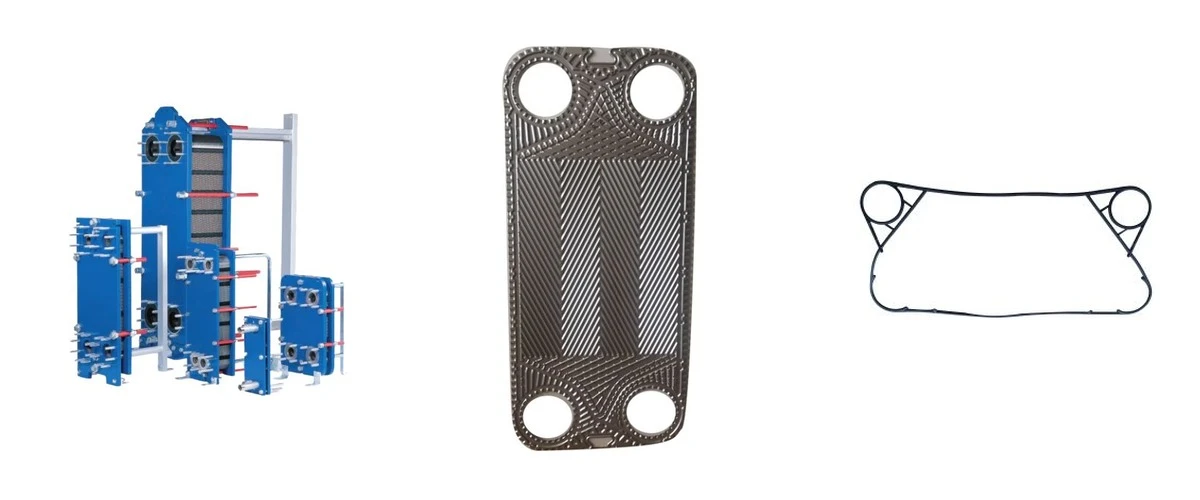
Complete Plate Heat Exchangers
Complete units selected according to process medium, thermal duty, flow rate, temperatures, pressure and cleaning conditions.
View Plate Heat Exchangers →Heat Exchanger Plates
Replacement or new-project plates matched according to exchanger model, plate geometry, material and operating environment.
View Heat Exchanger Plates →Heat Exchanger Gaskets
Replacement gaskets selected according to exchanger model, sealing profile, process medium, temperature, pressure and cleaning chemistry.
View Heat Exchanger Gaskets →Replacing Plates or Gaskets in an Existing Pharmaceutical PHE
Existing component identity and actual process conditions should be reviewed together before replacement components are confirmed.
Provide the existing exchanger manufacturer and complete model.
Send a clear photograph of the equipment nameplate.
Clear component photos support plate geometry and sealing-profile identification.
Include medium, temperatures, pressure, cleaning conditions and required quantity.
From Pharmaceutical Process Data to Product Selection
For a new project, provide process and utility media, flow rates, temperatures, pressure, allowable pressure drop and cleaning conditions. For an existing exchanger, also provide the brand, model, nameplate and clear component photos.
Prepare These Details Before Requesting a Quote
Heating, cooling, utility separation or heat recovery.
Exact pharmaceutical or medical-process liquid.
Heating water, cooling water or another utility.
Both-side flow rates with units.
Inlet and required outlet temperatures.
Working and design pressure.
Maximum allowable pressure drop.
Cleaning agent, concentration and temperature.
Brand and model for replacement requirements.
Required quantity and destination country.
Common Pharmaceutical Plate Heat Exchanger Questions
Provide the process and utility media, flow rates, inlet and outlet temperatures, working pressure, allowable pressure drop and cleaning conditions.
Plate heat exchangers can be used for heating and cooling duties involving process media with elevated cleanliness requirements when the exchanger selection, materials and project requirements are suitable for the application.
Selection should consider the actual process medium, chemical composition, temperature, cleaning chemistry and any customer-specific material requirements.
Cleaning chemistry may create different corrosion and gasket-compatibility conditions from normal production. Cleaner selection should therefore be reviewed together with plate and gasket materials.
Some viscous or particle-containing applications may require different channel geometry or wider flow passages. Provide viscosity, solids information and flow data for review.
Possible causes include deposits, increased viscosity, channel blockage, flow-rate changes or an unsuitable plate configuration.
Replacement matching can be reviewed using the existing exchanger brand and model, nameplate, component photos, dimensions, material, process medium and required quantity.
Send Your Pharmaceutical Process Data for Technical Review
Please provide process and utility media, flow rates, inlet and outlet temperatures, working pressure, allowable pressure drop and cleaning conditions. For replacement projects, include the existing brand, model, nameplate and component photos.
Request Pharmaceutical Technical Support →Pharmaceutical Plate Heat Exchanger Inquiry
Send your new-project or replacement information for review of a complete plate heat exchanger, replacement plate or compatible gasket.