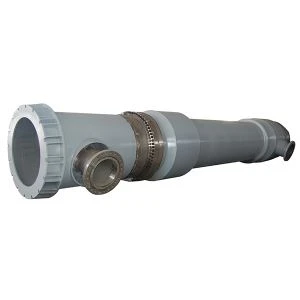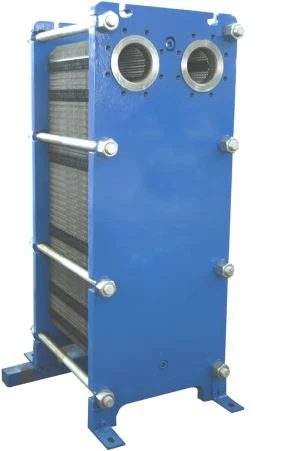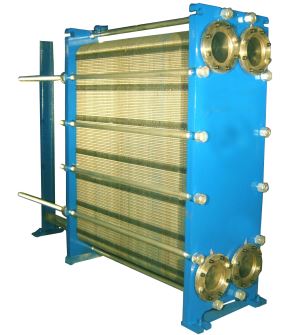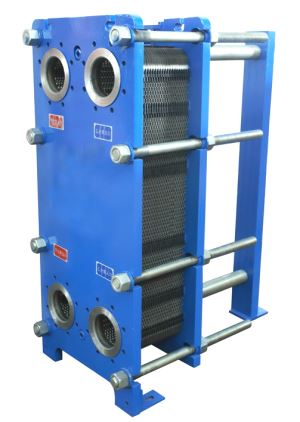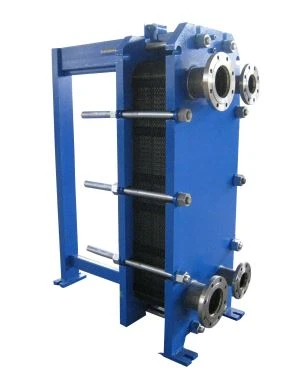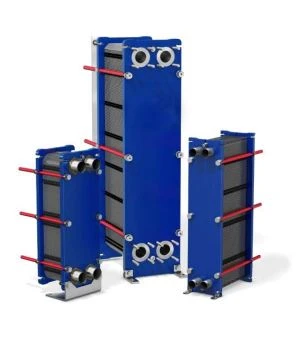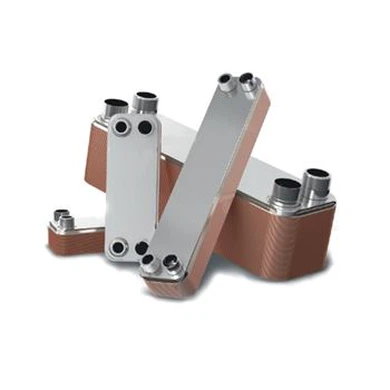

Original WTSML brazed plate heat exchanger product image.
Brazed Plate Heat Exchangers for Heating and Cooling
Industrial brazed plate heat exchangers use corrugated metal plates joined into a compact, permanently sealed heat-transfer core.
The brazed construction forms alternating fluid passages without the removable elastomer gaskets used in conventional gasketed plate-and-frame exchangers.
The appropriate unit must be selected according to process temperature, flow rate, allowable pressure drop, fluid compatibility and mechanical limits.
- Compact brazed plate construction
- Corrugated heat-transfer channel geometry
- Historical AISI 304, AISI 316L and nickel material references
- Threaded or flanged connection references
- Heating, cooling and suitable heat-recovery duties
- Model-specific replacement and technical selection support
How a Brazed Plate Heat Exchanger Works
A brazed plate heat exchanger consists of thin corrugated metal plates arranged to form narrow channels. Heat passes through the metal surfaces between two fluid streams.
The joining material bonds the plate edges and designated contact points into a permanent assembly. This differs from a gasketed heat exchanger that relies on a removable plate pack.
A counter-current flow arrangement is common for many liquid-to-liquid duties, although actual fluid routing and suitability depend on the model and application.
Compact Construction
A brazed core can provide significant heat-transfer surface within a small equipment envelope.
Permanent Plate Assembly
Joined plate edges and contact points create a non-serviceable plate core that is not opened like a gasketed plate pack.
Thermal Selection
Plate configuration, flow passages and working conditions determine the achievable heat duty.
Historical Product Technical Specifications
The following reference specifications are retained from WTSML's original Alfa Laval Brazed Plate Heat Exchanger listing.
| Product Type | Brazed Plate Heat Exchanger |
|---|---|
| Plate Material References | AISI 304, AISI 316L, Nickel |
| Maximum Working Pressure | 45 bar, historical product catalog reference |
| Connection Types | Threaded, Flanged |
| Plate Construction | Corrugated metal plates with brazed edges and contact points |
| Flow Arrangement | Model- and application-specific |
| Heat Transfer Area | To be confirmed for selected model |
| Overall Dimensions | To be confirmed for selected model |
| Temperature Rating | To be confirmed for selected model |
| Connection Dimensions | To be confirmed by technical drawing |

Technical image from the original WTSML brazed plate heat exchanger page.
Corrugated Plate Design and Material Selection
The corrugated plate pattern influences the internal flow channels and heat-transfer behavior. The design must balance effective heat transfer against the pressure loss available on each circuit.
Material selection must consider both the heat-transfer plates and the joining material. Fluid chemistry, corrosion exposure, temperature and cleaning conditions can affect long-term suitability.
The final model should be assessed using the actual thermal duty rather than external dimensions alone.
Connection Layout and Installation Considerations
A brazed plate heat exchanger requires appropriate mechanical support. Process piping should not be used as the sole means of supporting the unit unless the manufacturer specifically permits such an arrangement.
When external pipe connections are joined, the applicable equipment instructions must be followed to prevent overheating, contamination and connection damage.
Insulation and condensate management may be required for low-temperature or chilled-water applications.

Original WTSML installation and connection reference image.
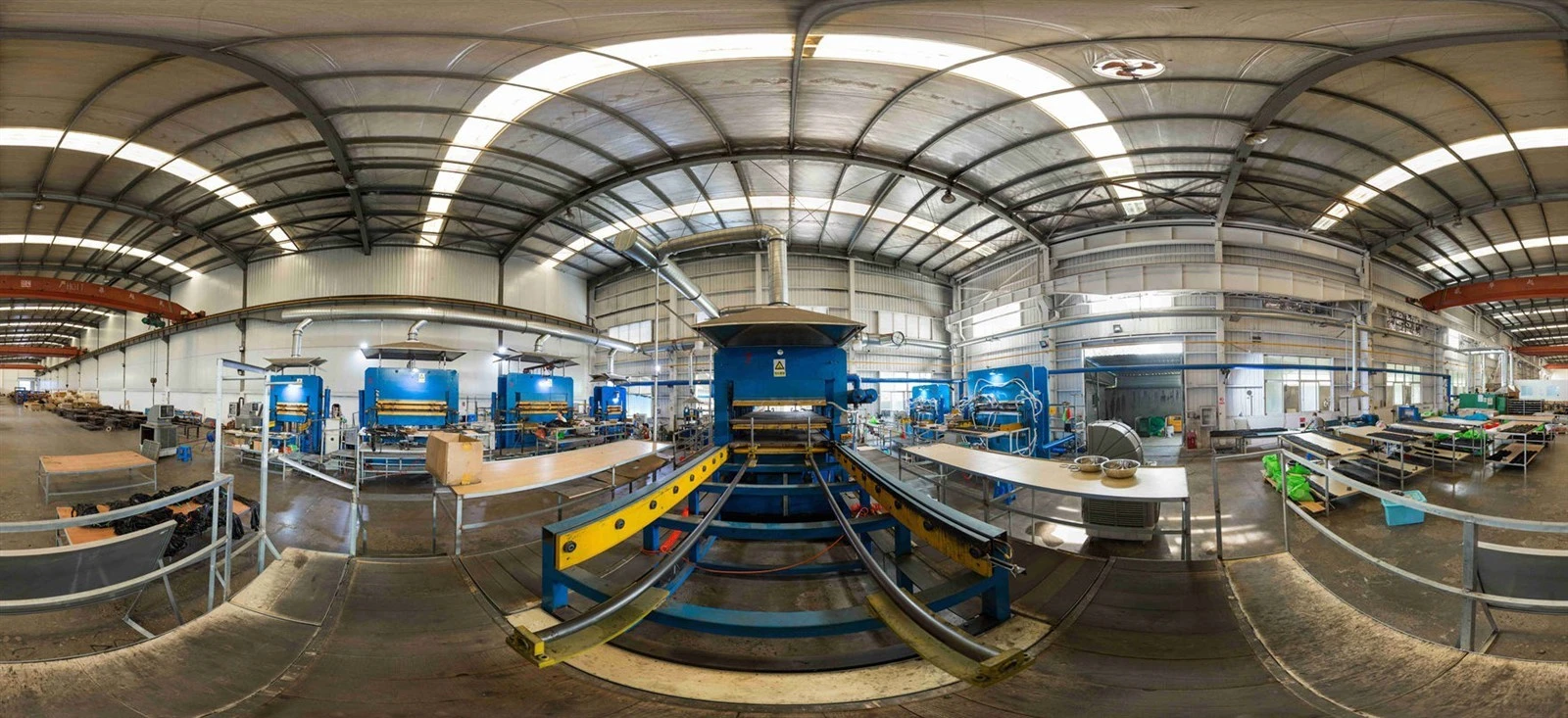
WTSML VR factory photo archive - industrial workshop reference.
Factory Environment and Product Verification
WTSML's factory photo archive provides a view of the industrial environment associated with heat-transfer equipment and component supply.
For brazed plate heat exchanger projects, procurement review should confirm the actual equipment source, material specification, mechanical ratings, connection details and relevant inspection documentation.
This factory photograph is not presented as proof of a specific copper or nickel brazing production line. Any manufacturing or testing requirements should be verified for the actual order.
Need a Brazed Plate Heat Exchanger or Replacement Unit?
Provide the original equipment model or your process conditions so the correct construction and thermal duty can be reviewed.
Industrial Applications for Brazed Plate Heat Exchangers
Brazed plate exchangers may be used across industrial heating and cooling processes where the selected construction and materials suit the operating media.
Water-to-Water Heating
Liquid heat transfer between compatible water-based circuits.
Process Cooling
Suitable industrial liquid cooling duties with defined thermal and hydraulic limits.
Heat Recovery
Transfer of recoverable thermal energy between compatible process streams.
HVAC Utility Systems
Selected heating and chilled-water applications where the exchanger meets design conditions.
Refrigeration Equipment
Application-specific refrigerant duties, subject to suitable pressure, temperature and material ratings.
Industrial Thermal Circuits
Compact heating and cooling equipment for appropriate industrial process media.
Replacement Enquiries for Alfa Laval Brazed Plate Heat Exchangers
Buyers replacing an existing Alfa Laval brazed plate heat exchanger should provide the complete original model, part number and nameplate details.
Replacement assessment must consider more than the external dimensions and connection sizes. The required heat duty, pressure drop, plate construction, joining material, design ratings and fluid compatibility must also be verified.
A visually similar brazed exchanger must not be assumed to be a direct drop-in replacement. Compatibility should be confirmed for the exact model and application before ordering.
Maintenance and Cleaning Considerations
Unlike a conventional gasketed plate heat exchanger, the plate pack inside a brazed unit is not normally dismantled for gasket or plate replacement.
Cleaning methods must be selected according to the actual plate material, brazing material, deposit type and equipment instructions. Incompatible cleaning chemicals or excessive pressure can damage the heat exchanger.
Freezing protection is especially important where water-containing media are exposed to low temperatures. System design should provide appropriate drainage, circulation or approved freeze protection as required.
Brazed Plate Heat Exchanger Quotation Checklist
For a new project or replacement unit, the following information supports a more accurate technical quotation.
| RFQ Information | What to Provide |
|---|---|
| Existing Equipment | Brand, full model, part number and nameplate photo |
| Hot Circuit | Fluid composition, flow rate, inlet and target outlet temperature |
| Cold Circuit | Fluid composition, flow rate, inlet and target outlet temperature |
| Hydraulic Conditions | Operating pressure and allowable pressure drop per circuit |
| Fluid Compatibility | Corrosion concerns, cleaning agents and special requirements |
| Connections | Thread or flange type, size, location and orientation |
| Installation | Available space, mounting requirements and insulation needs |
| Procurement | Quantity, delivery destination and requested documents |
Frequently Asked Questions About Brazed Plate Heat Exchangers
Brazed heat exchangers have permanently joined plate assemblies, while gasketed models use removable plates and elastomer gaskets. This affects maintenance, construction and equipment selection.
2. Is the maximum working pressure always 45 bar?No. The 45 bar figure is a historical product catalog reference. Actual working pressure depends on the specific model, temperature, construction and verified mechanical rating.
3. Can WTSML review a replacement for an Alfa Laval brazed plate heat exchanger?A replacement enquiry can be assessed when the existing model, nameplate, dimensions, connections and operating conditions are supplied. Interchangeability must be confirmed for the exact unit.
4. Can a brazed plate heat exchanger be opened to replace individual plates?Normally, no. The brazed core is permanently joined and is not opened like a gasketed plate-and-frame heat exchanger. Cleaning and replacement decisions depend on the unit's condition and manufacturer guidance.
5. What information is required to size a brazed plate heat exchanger?Provide both fluid streams, flow rates, inlet and outlet temperatures, allowable pressure drops, design conditions, fluid compatibility and connection requirements.
Related Heat Exchanger Products and Components
This page uses historical WTSML catalog information for brazed plate heat exchangers. Model-specific ratings, materials, drawings and replacement compatibility must be confirmed before quotation or purchase. Alfa Laval is the trademark of its respective owner. WTSML does not claim OEM affiliation or authorized status through this reference.
Hot Tags: brazed plate heat exchanger, China brazed plate heat exchanger manufacturers, suppliers