


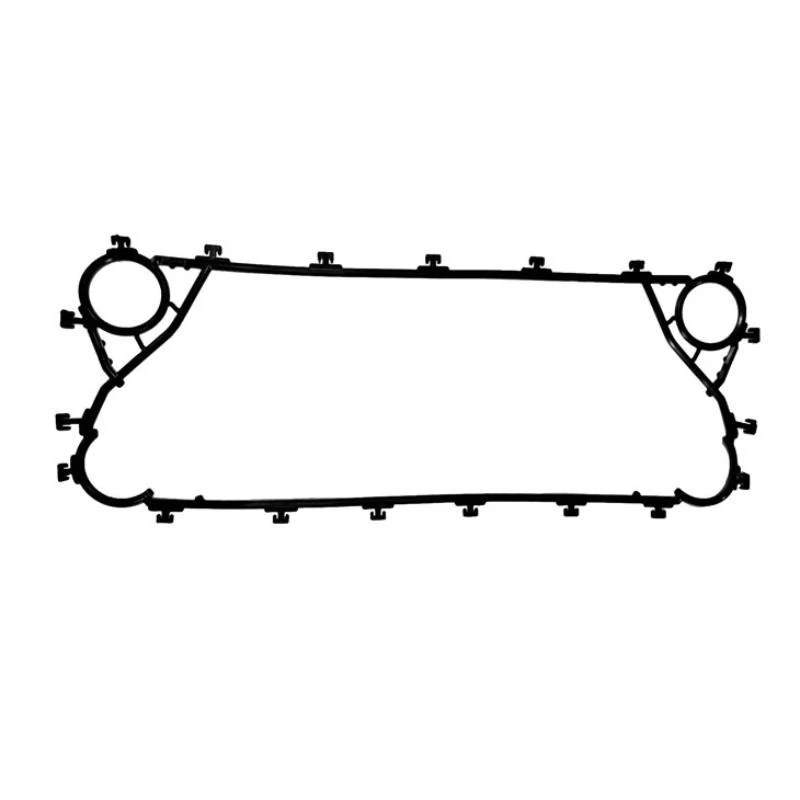
FKM Sealing for Identified APV Plate Heat Exchangers
APV Viton gaskets are independently manufactured FKM replacement seals for compatible gasketed APV plate heat exchanger configurations. Reliable replacement requires both an exact match to the plate sealing groove and confirmation that the selected FKM grade suits every process fluid, cleaning chemical, operating temperature, and pressure condition.
Where FKM May Be Considered
- Selected hydrocarbon, fuel, lubricant, and oil-related services
- Processes involving chemicals compatible with the specified FKM compound
- Operating conditions where heat and chemical resistance exceed standard elastomer requirements
- Maintenance projects requiring a material change after an engineering compatibility review
What Must Be Confirmed
- Complete exchanger and plate identification
- Gasket attachment method and sealing-profile geometry
- Fluid names, concentrations, additives, and possible contamination
- Normal, cleaning, start-up, and upset conditions
Match the Gasket Profile and Elastomer
A chemically suitable material cannot seal correctly if the gasket does not follow the plate groove, port-ring geometry, vent arrangement, and attachment points. Conversely, a dimensionally correct gasket can fail early when the elastomer is incompatible with the process.
| Selection factor | Information to verify | Why it matters |
|---|---|---|
| Plate identity | APV exchanger model, plate code, plate dimensions, and clear photos | Confirms the sealing path, port positions, and gasket profile. |
| Attachment design | Clip-on, snap-in, inserted, or glued configuration | Determines how the gasket is retained during plate-pack assembly. |
| Process media | Fluids on both circuits, concentration, additives, and contaminants | Supports compound compatibility screening for all wetted conditions. |
| Operating cycle | Normal and maximum temperatures, pressure, starts, stops, and thermal cycling | Affects compression retention, aging, and long-term sealing behavior. |
| Cleaning procedure | CIP chemicals, concentration, temperature, contact time, and rinse sequence | Cleaning exposure can be more demanding than the normal process fluid. |
| Order scope | Plate quantity, spare allowance, labeling, and packing requirements | Helps organize complete maintenance sets and repeat-order identification. |
When to Evaluate FKM Instead of EPDM or NBR
The existing gasket material is a useful starting point, but it should not be changed solely because another elastomer has a higher temperature rating. Fluid chemistry and cleaning exposure remain essential selection factors.
FKM
Often evaluated for selected hydrocarbons, oils, chemicals, and elevated-temperature duties. Exact compound compatibility must be checked before ordering.
NBR
Commonly considered for many oil, grease, and utility applications. Suitability varies with oil composition, additives, temperature, and cleaning media.
EPDM
Commonly used for water, hot-water, and compatible aqueous duties, but generally not selected for hydrocarbon oils and fuels.
Information Needed to Confirm an APV Viton Gasket
Identify the exchanger
Provide the APV model, nameplate photo, plate code, and any available maintenance records.
Document the gasket
Send clear front and rear photos of an intact gasket, including ports, corners, clips, tabs, and markings.
Measure the plate
Include overall plate length and width, port diameter, port-center spacing, and plate quantity.
Describe both fluids
List fluid names, concentrations, additives, contaminants, and which circuit contacts each gasket section.
State operating conditions
Include temperatures and pressures during normal operation, cleaning, start-up, shutdown, and possible upset events.
Define order requirements
Confirm the required quantity, spare sets, destination country, labeling, and packaging instructions.
Replacement Gaskets Prepared for Maintenance Work
Production and Inspection
WTSML manufactures replacement plate heat exchanger components in a 3,500 m² facility with rubber molding, precision stamping, CNC machining, and final-inspection workshops. Production processes operate under an ISO 9001-certified quality management system.
- Profile and attachment features checked against the confirmed reference
- Material and order identification maintained through production
- Visual and dimensional checks completed before packing
Packaging and OEM Requirements
Gaskets can be grouped by exchanger, maintenance set, or purchase-order line. OEM and distributor orders may include confirmed private-label and packaging requirements.
- Separate labels for different models or gasket materials
- Quantity grouping for scheduled shutdown work
- Export packaging requirements confirmed before production
Protect the New Seal During Plate-Pack Assembly
Clean the Groove
Remove residual elastomer, adhesive, deposits, and oil without damaging the plate or sealing groove.
Inspect Every Plate
Check sealing surfaces, gasket grooves, port areas, and attachment points for deformation, cracks, or corrosion.
Control Compression
Align the plate pack and tighten the frame evenly according to the exchanger's approved assembly procedure.
APV Viton Gasket FAQ
Are APV Viton gaskets suitable for every APV heat exchanger?
No. The exchanger must use a replaceable gasketed plate configuration, and the gasket profile must match the specific plate and attachment design. FKM compatibility with the process and cleaning media must also be confirmed.
Can FKM replace an existing EPDM or NBR gasket?
A material change may be possible only after reviewing both process circuits, cleaning chemicals, temperatures, pressures, and the required sealing profile. FKM should not be selected from temperature resistance alone.
What should I send if the APV model number is unreadable?
Send exchanger and plate photos, an intact gasket sample or detailed images, overall plate dimensions, port diameter, port-center spacing, attachment details, and any readable plate or gasket markings.
Should cleaning chemicals be included in the material review?
Yes. State each cleaner, concentration, cleaning temperature, exposure time, and frequency. Cleaning conditions can be more demanding for the elastomer than the normal operating fluid.
Can the gaskets be packed as complete maintenance sets?
Yes. Confirm the exchanger identification, plate-pack quantity, spare allowance, and labeling requirements so the order can be grouped for maintenance or distributor inventory.
Are these original APV gaskets?
No. They are independently manufactured replacement gaskets intended for confirmed compatible APV gasketed plate heat exchanger applications. The APV name is used only to identify compatibility requirements.
Confirm the APV Gasket Before Ordering
Send the exchanger model, plate or gasket photos, dimensions, FKM requirement, process fluids, temperatures, pressures, cleaning conditions, quantity, and destination country.
Hot Tags: apv viton gaskets, China apv viton gaskets manufacturers, suppliers, APV Compatible Gaskets, APV EPDM Gaskets, apv gaskets, APV NBR Gaskets, APV Plate Heat Exchanger Gaskets, APV Replacement Gaskets


