


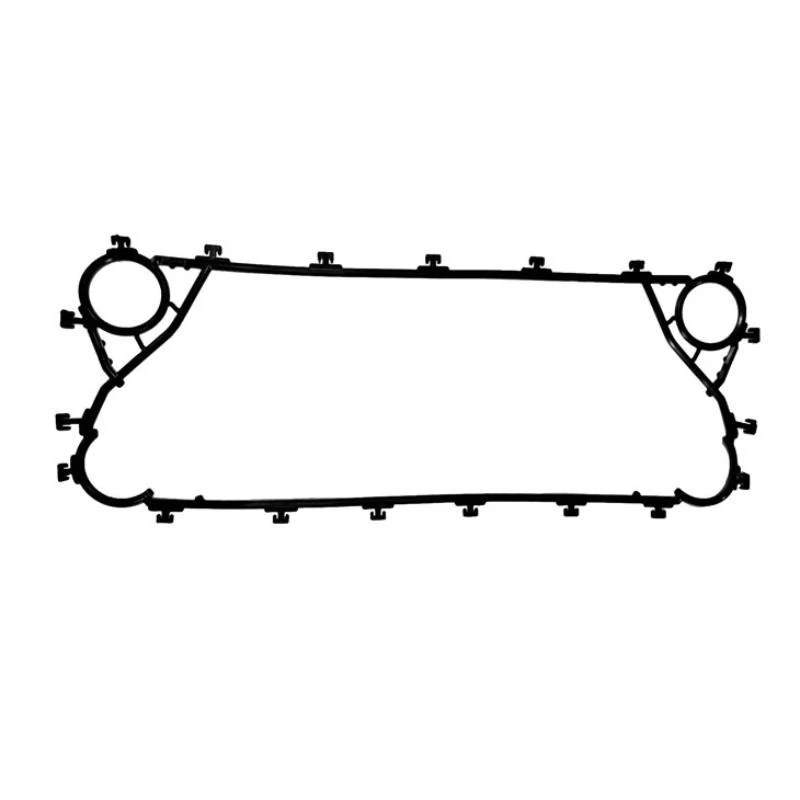
Hisaka EPDM Gaskets
Leakage Is Often Caused by Uneven Compression, Not Material Failure
In many Hisaka plate heat exchangers, gasket failure is not related to EPDM performance itself, but to uneven compression across the plate pack.
Over time, small mechanical changes in the frame or plate stack can lead to inconsistent sealing pressure, causing localized leakage or premature gasket wear in specific areas.
WTSML manufactures OEM-compatible Hisaka EPDM gaskets designed to perform reliably even under non-uniform compression conditions.
Why Leakage Appears Only in Certain Areas
In real industrial operation, gasket wear is often uneven.
Typical patterns include:
- Leakage on one side of the plate pack
- Faster wear on inlet or outlet zones
- Localized gasket deformation
- Uneven sealing marks after shutdown
- Repeated failure at the same position
These symptoms often indicate mechanical imbalance rather than material degradation.

Typical Applications
OEM-compatible Hisaka EPDM gaskets manufactured by WTSML are widely used in:
- Water treatment systems
- HVAC cooling circuits
- Food processing with water-based media
- Chemical utility systems
- Industrial heat recovery
- General process cooling applications
These systems often involve large plate packs where compression distribution is critical.
Manufacturing Focused on Dimensional Stability
WTSML ensures consistent gasket performance through:
- Precision mould tooling
- Stable EPDM compound selection
- Strict dimensional inspection
- Controlled curing process
- Batch consistency control
- Final quality verification
These controls help ensure predictable sealing behavior under real installation conditions.
Compression Distribution Affects Sealing Life
Plate heat exchangers rely on uniform compression force to maintain sealing integrity.
However, over long-term operation, several factors can affect balance:
- Frame fatigue or slight deformation
- Incorrect tightening sequence during maintenance
- Plate pack misalignment
- Uneven bolt torque application
- Replacement of mixed plate types
These issues create non-uniform sealing pressure across the gasket surface.
EPDM Performance Depends on Mechanical Conditions
Even high-quality EPDM gaskets cannot compensate for poor compression distribution.
When pressure is uneven, it can result in:
- Local over-compression and permanent deformation
- Under-compressed zones leading to leakage
- Accelerated wear at stress concentration points
- Reduced overall gasket lifespan
This is why mechanical conditions must be evaluated together with material selection.
Maintenance Practices to Improve Compression Balance
To reduce uneven sealing issues, maintenance teams often focus on:
- Controlled bolt tightening sequence
- Torque calibration tools
- Plate alignment inspection
- Frame straightness verification
- Even distribution of compression force
Proper installation practices significantly improve gasket performance consistency.
Engineering Support for Leakage Diagnosis
Recurring leakage is often a system-level issue rather than a material defect.
WTSML provides engineering support for:
- Leakage position analysis
- Compression distribution review
- Plate pack condition assessment
- Installation method evaluation
- Replacement strategy planning
Improve Sealing Performance by Balancing the System
Reliable sealing depends not only on gasket material, but also on how evenly the system applies compression.
If you are sourcing Hisaka EPDM gaskets, WTSML can support you with OEM-compatible solutions and engineering guidance to improve compression balance and extend gasket service life.
Hot Tags: hisaka epdm gaskets, China hisaka epdm gaskets manufacturers, suppliers, Hisaka Compatible Gaskets, Hisaka EPDM Gaskets, hisaka gaskets, Hisaka NBR Gaskets, Hisaka Plate Heat Exchanger Gaskets, Hisaka Replacement Gaskets

