


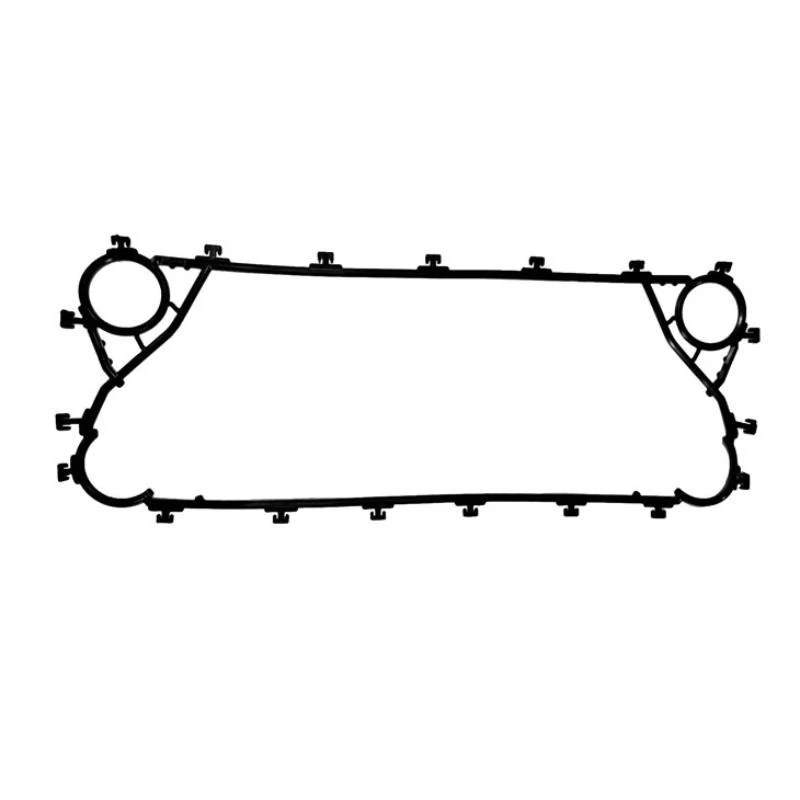
GEA Compatible Gaskets
Many replacement gaskets appear almost identical when placed side by side. However, successful installation depends on much more than matching the overall outline.
A gasket must follow the exact sealing path designed for the plate. Even small differences in the groove profile or locking points can affect sealing pressure, causing leaks or making installation difficult.
WTSL manufactures GEA compatible gaskets with attention to the critical dimensions that determine whether a gasket performs correctly after installation-not simply whether it resembles the original.

What Makes a Gasket Truly Compatible?
Compatibility is determined by how the gasket interacts with the plate during assembly and operation.
Our engineering team evaluates multiple characteristics before confirming a replacement design, including:
- Sealing bead geometry
- Port ring dimensions
- Locking clip position
- Rubber cross-section
- Compression height
- Plate groove engagement
- Thermal expansion characteristics
Matching these features is far more important than matching the outside shape alone.
Compatibility Is Different from Interchangeability
A gasket described as "compatible" should be capable of performing the same sealing function on the intended plate model without requiring changes to the equipment.
However, compatibility should always be verified against technical data rather than assumptions based on appearance.
For this reason, WTSL reviews customer information before production instead of supplying generic parts.
How We Confirm Compatibility Before Manufacturing
Every enquiry follows a verification process designed to minimise ordering errors.
Depending on the information available, our engineers may compare:
Plate model references
Existing plate identification provides the quickest route to confirming the correct gasket profile.
Existing gasket samples
A used gasket reveals important information about locking features, sealing paths and material thickness.
Plate photographs
High-resolution images help identify plate patterns and gasket groove layouts.
Technical drawings
Where available, engineering drawings allow direct dimensional comparison before mould selection.
Why Small Dimensional Differences Matter
Several dimensions have a direct influence on sealing reliability.
For example:
- A locking tab positioned only a few millimetres away from its intended location may prevent the gasket from seating correctly.
- An oversized port opening can reduce sealing pressure around fluid channels.
- Incorrect compression height may lead to uneven tightening across the plate pack.
These details are often overlooked but are critical for long-term performance.
Compatibility Support for Older and Discontinued Models
Some GEA heat exchangers remain in operation long after their original spare parts become difficult to source.
In these cases, compatibility verification often relies on physical samples rather than current catalogue references.
Our engineering team can evaluate legacy models using:
- Existing plates
- Worn gasket samples
- Nameplate information
- Dimensional measurements
- Historical production drawings
This approach helps customers maintain older equipment without replacing the entire heat exchanger.
Before We Recommend a Replacement
Rather than asking customers to identify every technical detail, we simply request whatever information is available.
Useful references include:
- Equipment nameplate
- Plate model
- Plate quantity
- Gasket material (if known)
- Process medium
- Operating temperature
- Photographs of the plate or gasket
Even partial information is often enough to begin compatibility verification.
Hot Tags: gea compatible gaskets, China gea compatible gaskets manufacturers, suppliers, GEA Compatible Gaskets, GEA EPDM Gaskets, GEA NBR Gaskets, GEA Plate Heat Exchanger Gaskets, GEA Replacement Gaskets, GEA Viton Gaskets